Stiff Dough, a Cold Night and a Kettle That Should Not Roar
Bagel dough is stiff on purpose. At around 57% hydration it is dry enough to fight you, and that is the point. Less water means the gluten proteins sit closer together and the network they form is dense, tight and elastic rather than slack, which is what lets a shaped ring hold its shape through a boil and then resist the oven's push outward. Flour strength matters as much as the ratio. You want roughly 14% protein, a strong bread flour or a high-gluten flour, because a weak flour tears under the tension of a stiff dough and bakes into something closer to a soft roll. Water quantity also sets the crumb itself. The less water the dough carries, the less steam there is to inflate the interior, so a bagel comes out close-textured and chewy rather than open and airy.
The overnight rest in the refrigerator is doing three things at once, and none of them can be hurried at room temperature. The first is flavour: yeast stays alive at 4°C but works slowly, and a slow ferment produces a different set of by-products from a fast one, including more organic acids and alcohols, which is where the faint sourness and depth in a good bagel comes from. The second is sugar. Enzymes naturally present in the flour keep breaking starch down into maltose through the night, and whatever the yeast has not eaten by morning is left on the surface to brown in the oven. The third is the crust. Cold dough hitting boiling water is what makes the blisters: the surface starch sets almost instantly while gas in the outermost layer is still expanding, so tiny bubbles are locked in place and bake into the speckled, bubbled shell you see on a real New York bagel.
The kettle is what turns dough into a bagel. Starch granules begin to absorb water and swell at around 60°C, and in water near boiling they do it fast and irreversibly: within a minute the surface starch has gelatinised into a continuous gel layer a couple of millimetres deep. That layer does several jobs at once. It sets the ring's final size, because once the outside is rigid the bagel can no longer expand outward. It seals the surface enough to hold the interior's steam in check, so oven spring is limited and the crumb stays dense. And it leaves the crust loaded with gelatinised starch that dries, dextrinises and browns into a glossy, chewy shell. Thirty seconds a side gives a thin, pale shell and a softer chew. Ninety seconds a side is the Montreal profile, leathery and very tight. One to two minutes a side is the New York middle ground.
There is a persistent instruction to boil bagels in a hard, rolling boil, and it is bad advice. Gelatinisation at the surface happens just as fast at a lively simmer, because the water is at the same temperature either way. What a rolling boil adds is turbulence, and turbulence damages the thing you spent twelve hours proofing. Fragile, gas-filled dough gets knocked against the sides of the pot and against its neighbours, the surface bruises, and bagels come out deflated or lopsided. A hard boil also makes the water foam, and with malt syrup in the kettle that foam climbs quickly and can put out a gas burner. Keep it at a steady simmer with bubbles breaking steadily across the surface. The malt in the water coats the surface with sugar for colour, and a spoonful of baking soda raises the pH, which speeds browning and gives the crust a faintly alkaline, pretzel-like edge.
Bagels bake hot, at 220°C to 230°C (425°F to 450°F), which is hotter than most bread, and the reason is the boil. The crust arrives in the oven already cooked and already coated in sugar, so the window between browned and burnt is short, and you need the interior to set before you reach the end of it. At a lower temperature the outside would dry and colour slowly while the middle stayed pale and stodgy. The flip is a New York bakery habit that has survived because it works. Traditionally the boiled bagels go onto wet burlap-covered wooden boards, bake five to seven minutes, then get flipped off the board directly onto the hot stone. The move rescues the underside, which spent those first minutes sitting on a wet board and would otherwise stay pale and soft. Flip at the halfway point and you get two properly browned crusts.
Barley malt syrup belongs in both the dough and the kettle, and the distinction that matters is diastatic against non-diastatic. Diastatic malt still contains active enzymes, so it keeps converting starch in the dough, which is useful in a long-fermented bread but can turn a stiff bagel dough slack and sticky across twelve hours in the fridge. Non-diastatic malt has had its enzymes deactivated, so it contributes sugar and flavour and nothing else. In the dough it feeds the yeast and deepens the colour. In the kettle it coats the surface in a film of maltose and glucose that dries onto the crust, where it drives Maillard browning and caramelisation hard in a hot oven. That is the malty, faintly sweet note and the deep amber colour people mean when they say a bagel tastes like New York. Dark brown sugar or molasses will stand in, but molasses carries a bitterness malt does not.
The New York water story is folklore, and it is worth saying so plainly. The claim is that the city's water has a mineral profile, calcium and magnesium in particular, that firms up gluten and feeds yeast in a way you cannot reproduce elsewhere. There is no good evidence for it. New York bakeries filter their water, some run it through reverse osmosis, and excellent bagels are made in cities with completely different water. Nobody has demonstrated the difference in a controlled comparison, and most people repeating the claim are repeating something they were told. What actually explains the bagels is unglamorous and entirely reproducible at home: flour at around 14% protein, a stiff dough near 57% hydration, an overnight cold ferment, a malted kettle for one to two minutes a side, and a hot oven with a flip halfway. If your tap water is very soft or heavily chlorinated, filtered or bottled water is a reasonable precaution. Otherwise your water is fine.
Boiling Time and What It Does to the Crust
| Boiling Time per Side | Crust Characteristic | Interior Crumb | Recommended Use |
|---|---|---|---|
| 30 Seconds | Thin, delicate crisp shell | Slightly open, softer chew | Delicate breakfast rolls |
| 60 Seconds (Standard NYC) | Thick, glossy, micro-blistered | Dense, chewy, elastic crumb | Authentic NY Deli Style |
| 90 Seconds (Montreal Style) | Extra-chewy, thick leather crust | Very dense and tight | Wood-fired style bagels |
| 120+ Seconds | Tough, dull shell; seals crumb | Heavy, gummy, dense brick | Overboiled; avoid |
| No boil at all | Pale, matte, no blister | Open, bread-like and soft | Not a bagel; this is a roll |
| 60 Seconds, one side only, not flipped | Glossy on top, pale and dry underneath | Uneven, slightly open toward the base | Workable in a hurry, but the flip is worth the extra minute |
Ingredients
Checklist- 500g (3.5 cups) High-Protein Bread Flour (13-14% protein like King Arthur or bread flour)
- 285g (1.2 cups) Lukewarm Water (approx. 28°C / 82°F) — 57% hydration
- 4g (1 tsp) Instant Dry Yeast
- 10g (1.5 tsp) Fine Sea Salt
- 25g (1.5 tbsp) Non-Diastatic Barley Malt Syrup (or dark brown sugar)
- For Boiling Kettle: 4 Liters Water, 2 tbsp Barley Malt Syrup, 1 tbsp Baking Soda
- Toppings: Everything bagel seasoning, coarse sea salt, toasted sesame seeds, poppy seeds
Step-by-Step Method
- 1 Mix the Stiff Dough. In a mixer bowl, dissolve malt syrup and yeast in lukewarm water. Add flour and salt. Mix on low with dough hook for 3 minutes until shaggy, then knead on medium-low for 8-10 minutes. The dough will be remarkably stiff, smooth, and satin-firm.
- 2 Portion and Pre-Shape. Divide dough into 8 equal portions (approx. 100g each). Cup your palm over each piece and roll in circular motions against an un-floured wooden board to build high surface tension into smooth, taut balls. Rest 15 minutes covered.
- 3 The Traditional Hole-Poking Method. Dust your thumb with flour and press straight through the center of each dough ball. Gently stretch and spin the dough around your fingers in circular motions until the center hole expands to 2 inches wide (it shrinks back during proofing).
- 4 Cold Ferment Overnight (Retardation). Place shaped bagels on a parchment-lined baking sheet dusted with cornmeal. Wrap sheet tightly in plastic wrap. Refrigerate for 12 to 24 hours. The cold temperature develops deep complex lactic acid flavor.
- 5 Prepare the Malt Boiling Kettle. Bring 4 liters of water, malt syrup, and baking soda to a lively rolling boil in a wide pot. Preheat oven to 220°C (425°F) with baking stones or sheets inside.
- 6 The 60-Second Boil. Gently lower cold bagels into boiling water (3 at a time). Boil for 60 seconds, flip with a spider skimmer, and boil for 60 seconds on the reverse side. Remove and drain on a wire rack for 30 seconds.
- 7 Coat and Bake to Deep Golden. Immediately dip wet boiled bagels into bowls filled with everything seasoning or sesame seeds. Transfer to hot baking sheets. Bake for 18-22 minutes until deep amber brown and shiny. Cool on a wire rack 20 minutes before slicing.
The Pot, the Stone and the Rest of It
Key Advantages & Science
- ✓True New York chew — dense, elastic crumb with zero cake-like softness.
- ✓Shiny, micro-blistered crust with deep malty caramel notes.
- ✓Freezes whole or sliced for weeks without texture degradation.
- ✓Hand-rolling technique produces authentic, seamless round bagel rings.
Important Considerations
- !Requires overnight 12 to 24-hour cold retardation in the refrigerator.
- !Stiff dough requires significant arm stamina or a heavy-duty stand mixer.
- !Requires high-protein flour and barley malt syrup for authentic results.
Bagel Notes From Testing
Fault Diagnosis: Flat, Pale or Tough Bagels
| What Went Wrong | Most Likely Cause | The Fix Next Time |
|---|---|---|
| Bagels deflated and sank to the bottom of the kettle | They were over-proofed during a room-temperature rest, or allowed to warm up before boiling | Take them straight from the refrigerator to the kettle, and never let shaped bagels sit out to take the chill off |
| Crust is dull, pale and matte with no shine | No malt in the boiling water, an under-boiled batch, or an oven running cool | Boil the full 1 to 2 minutes per side in malted water and verify your oven with a thermometer before the bake |
| The centre hole closed up completely during baking | The hole was stretched too small when shaping, or the dough was left to proof too long | Stretch the hole to about 5cm wide and shape with a floured thumb so the ring stays open as it springs |
| Bagels came out like soft bread rolls | All-purpose flour, hydration too high, or the boil was skipped or cut short | Use flour at 14% protein, keep the dough near 57% hydration, and boil at least 60 seconds on each side |
| Crust is leathery and the crumb is heavy and tight | Boiled too long, well past two minutes a side | Pull back to 60 to 90 seconds per side; the gelatinised layer only needs a minute to form and keeps thickening after that |
| Everything seasoning slid off in the oven | Toppings were pressed onto bagels that had already dried after coming out of the kettle | Dip within 30 seconds of lifting each bagel from the water, while the surface is still tacky, or brush with egg white first |
| The kettle foamed up and boiled over | Malt syrup plus baking soda in a deep pot over high heat | Use a wide shallow pan no more than half full, hold it at a simmer rather than a rolling boil, and add a teaspoon of oil to settle the foam |
Rye, Raisin, Montreal and Other Directions
Soak 100g of raisins in hot water for ten minutes and pat them thoroughly dry before kneading them in at the end of mixing, otherwise they wick water out of an already stiff dough and leave dry pockets around each one. Add 2 teaspoons of ground cinnamon with the flour, and expect a slightly slower rise because cinnamon inhibits yeast. After boiling, roll the wet bagels in cinnamon sugar rather than adding more to the dough; the sugar on the surface caramelises in the oven and gives the crust its dark, crackling top.
Replace 150g of the bread flour with dark rye flour, add a tablespoon of cocoa powder and a teaspoon of caraway seed. Rye brings pentosans rather than gluten, so it absorbs more water and the dough turns noticeably stickier and less elastic; hold back 20g of the water until you see how it behaves and be prepared to add a little more. The rise will be smaller and the crumb tighter, which suits the boil. Bake two minutes longer than the plain version, since the sugars in rye brown more slowly.
Boil in water with honey instead of barley malt and leave out the baking soda, then boil 90 seconds a side rather than 60. Shape them smaller and with a bigger hole, and bake on a hot stone in a wood-fired or very hot oven for a shorter time so they come out denser, a little sweeter and noticeably darker than a New York bagel. The honey bath gives a thinner, harder shell rather than the blistered one, and the smaller size means the dough is even stiffer relative to its surface, which is why the chew is so tight.
The same dough, shaped the same way, and then pressed flat from the middle outward with your fingertips into a disc about 10cm across with a deep dimple in the centre rather than a hole. Let them proof at room temperature for 45 minutes, fill each dimple with a spoonful of fried onion and poppy seed, and bake at 220°C (425°F) for 12 to 15 minutes without boiling. Because they skip the kettle, they come out with a soft, pale, floury outside and a dense chewy middle, which is the whole point of a bialy.
What Actually Belongs on a Bagel
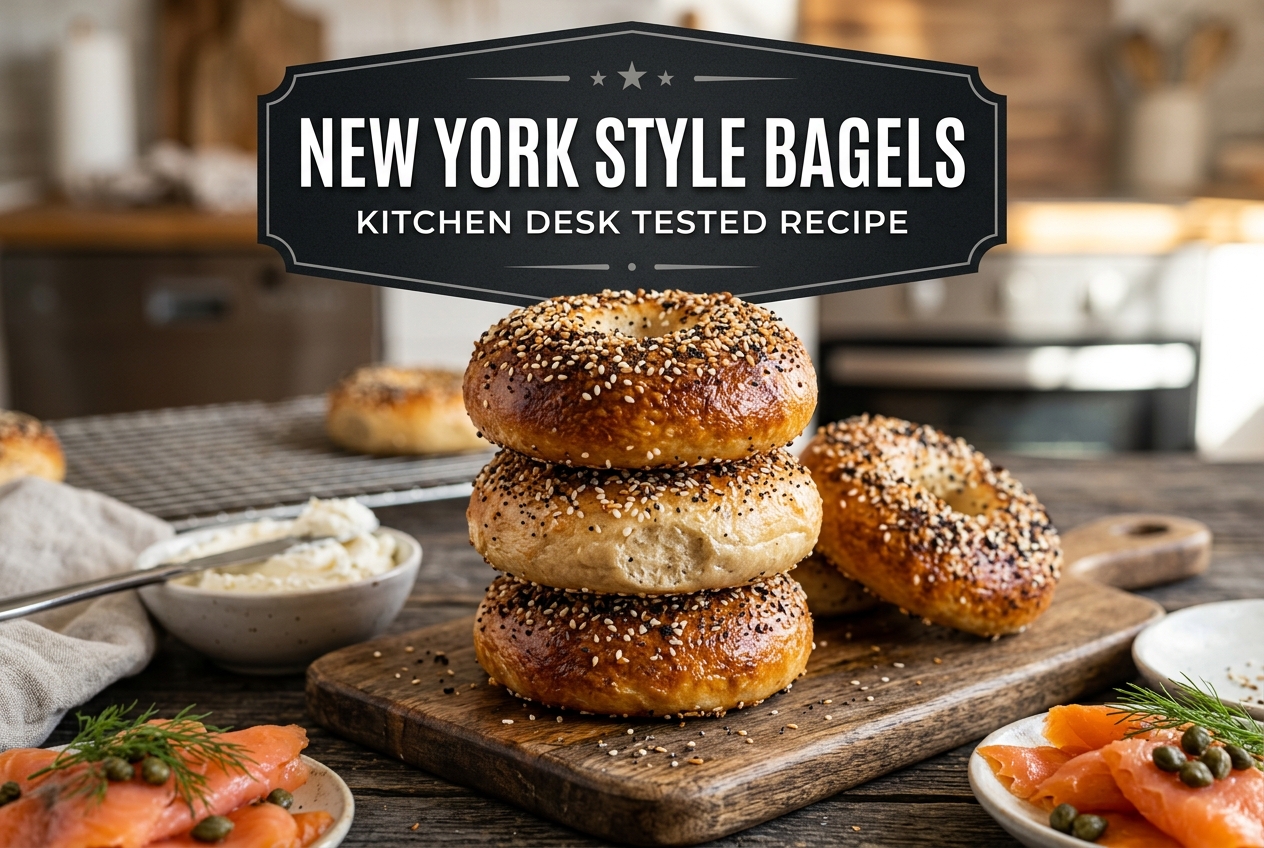
A bagel baked this morning needs nothing done to it. Toasting exists to rescue a stale bagel, and it also drives off the last of the surface moisture that makes the crust worth having, so slice a fresh one, schmear it and eat it. If you are toasting, split it first and go cut-side up under a hot broiler or in a dry pan rather than a slot toaster, which steams as much as it toasts. Cream cheese should be at room temperature and spread thin; cold cream cheese tears the crumb, and a thick layer buries the malty crust under dairy. From there, the classic New York plate is lox or nova, a slice of tomato, thin red onion, capers and a grind of black pepper, with the bagel halves left open rather than closed so nothing goes soft. Elsewhere, the same bagel carries butter and jam, peanut butter and banana, egg and cheese, or a tunafish or chicken salad made with a little less mayonnaise than usual because the bread brings plenty of richness of its own. Beside it, keep the rest of the plate sharp and cold: a dill pickle spear, a handful of cherry tomatoes, sliced cucumber with salt, or a glass of orange juice and strong coffee. A bagel is breakfast on its own, so build the plate around cutting the fat rather than adding to it.
Keeping a Bagel Edible Past Tuesday
Store in a paper bag for 24 hours. For long-term storage, slice bagels in half and freeze in zip-top bags; toast straight from frozen.