Ingredients
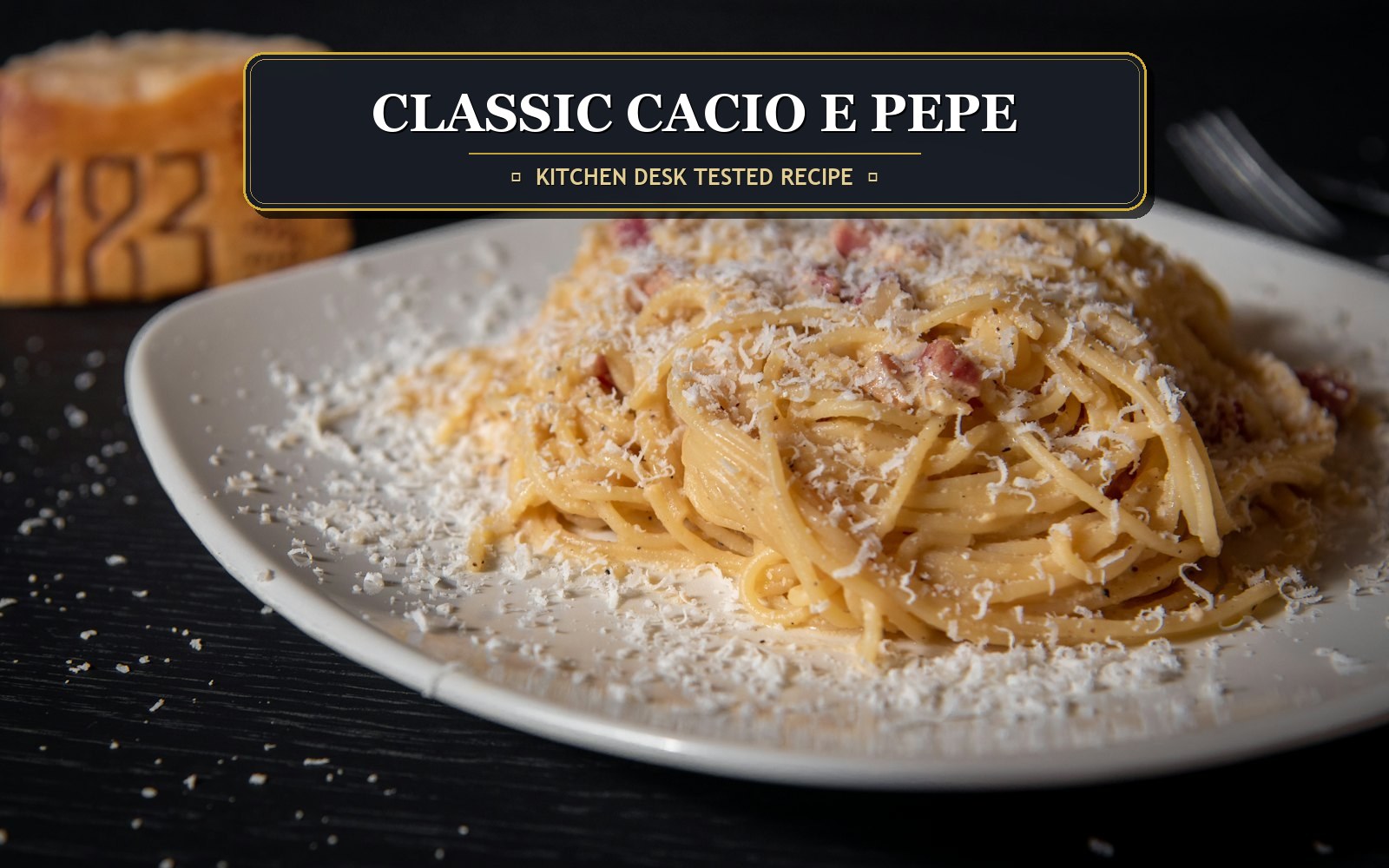
Checklist- 200g Bronze-cut Spaghetti, Tonnarelli, or Bucatini
- 80g Aged Pecorino Romano DOP (very finely microplaned)
- 1.5 tbsp Whole Black Tellicherry Peppercorns
- 1.5 liters Water (boiled with 1 tsp salt, shallow water for concentrated starch)
Step-by-Step Method
- 1 Crush & Toast Peppercorns: Coarsely crush whole peppercorns in a mortar. Add to a wide dry skillet over medium heat and toast for 2 minutes until fragrant.
- 2 Boil in Low Water: Boil pasta in only 1.5 liters of lightly salted water. A lower water volume concentrates the dissolved starch, which is the emulsifier.
- 3 Deglaze Pepper Pan: Ladle 100ml of boiling pasta starch water into the toasted pepper pan; let it simmer into a starchy broth.
- 4 Make Cheese Paste (Cremina): In a heat-safe bowl, whisk the finely grated Pecorino with 60ml of warm pasta water until it forms a smooth, lump-free paste.
- 5 Transfer Pasta Al Dente: Using tongs, transfer pasta 2 minutes before al dente directly into the pepper skillet. Toss constantly over low heat so pasta finishes cooking in the pepper broth.
- 6 The Critical Mantecatura: Remove skillet from direct heat and let cool for 60 seconds (down to ~58°C). Pour in the cheese paste. Vigorously toss and stir with tongs until a glossy, creamy sauce coats every strand.
Why Cacio e Pepe Breaks, and the Emulsion That Prevents It
Cacio e Pepe is a thermodynamic balancing act. Pecorino Romano is a sheep's milk cheese with a melting point of approximately 55°C (131°F). If combined with boiling water above 65°C (149°F), the milk proteins coagulate and seize into a stringy, rubbery clump, separating from the butterfat. By creating a cold cheese paste with lukewarm starch water and cooling the pasta slightly in the skillet before tossing (mantecatura), the amylose starches encapsulate the fat droplets, forming a luxurious permanent emulsion.
What you are actually building is an emulsion, and it helps to be precise about what that means. Fat and water do not mix; left alone they separate into layers. An emulsifier is a molecule that can hold onto both at once, keeping microscopic fat droplets suspended in water so the mixture reads as a single creamy liquid. In a French sauce that job is usually done by egg yolk lecithin or by butter's own milk proteins. Here it is done by starch — specifically amylose, the long straight-chain molecule that leaches out of pasta as it boils. Amylose wraps around fat droplets and physically prevents them from finding each other and coalescing.
This is why the water volume in the pot matters more than almost anything else in the recipe. Starch concentration, not starch quantity, is what determines whether the emulsion holds. Boiling 200g of pasta in five litres of water releases exactly the same amount of starch as boiling it in 1.5 litres, but the resulting liquid is three times more dilute and simply cannot do the job. Cook in a narrow, shallow pot with just enough water to cover, and the cooking liquid finishes visibly cloudy and faintly viscous — that cloudiness is the sauce.
The salt in the pasta water needs adjusting downward for the same reason, and this trips people up. Standard advice is to salt pasta water aggressively, but Pecorino Romano DOP is a heavily salted cheese, and 80g of it carries a great deal of sodium into a dish for two. Combined with concentrated, low-volume cooking water, generously salted water produces something close to inedible. A single teaspoon in 1.5 litres is deliberate: the cheese does the seasoning.
The failure everyone experiences is protein coagulation, and it is worth knowing exactly what breaks. Cheese is a matrix of casein proteins holding fat globules in place. Warmed gently, the matrix relaxes and the fat is released smoothly into the surrounding liquid. Heated past roughly 65°C, the casein molecules denature — they unfold and then bond tightly to each other, contracting into a rubbery mass and squeezing the fat out as a greasy puddle. This is irreversible. No amount of stirring, added water or lowered heat will bring a seized sauce back, which is why the sixty-second pause off the heat is not a suggestion.
Grating the cheese finely is a surface-area problem rather than a matter of neatness. A microplane produces a fluffy powder with enormous surface area relative to its mass, so each fragment melts almost on contact with warm liquid. Coarse shreds from a box grater have far less surface area per gram, so their exteriors melt while their cores are still solid — the melted outsides bond to each other and form clumps around unmelted centres. Pre-grated supermarket cheese is worse again, because it is dusted with cellulose or potato starch specifically to stop the shreds sticking together, which is the opposite of what this sauce requires.
The pepper deserves more attention than it usually gets, since it is one third of the dish. Black pepper's heat comes from piperine and its aroma from volatile terpenes, and those aromatics are largely locked inside the peppercorn until it is cracked. Pre-ground pepper has been losing them since the day it was milled. Crushing whole peppercorns coarsely just before cooking releases them, and toasting the crushed pepper briefly in a dry pan drives off residual moisture and blooms the fat-soluble aromatics — which is why the dish smells fundamentally different when this step is not skipped. Deglazing that toasted pepper with starchy water then extracts the flavor into the liquid that becomes the sauce.
Emulsion Temperature Matrix
| Skillet Temp | Reaction of Pecorino Romano | Resulting Sauce Quality |
|---|---|---|
| Below 50°C (122°F) | Cheese does not melt sufficiently | Grainy, watery sauce |
| 55°C - 60°C (131°F - 140°F) | Optimal melting & starch bonding | Velvety, glossy cream coating every strand |
| Above 65°C (149°F) | Proteins denature & separate from fat | Rubbery, stringy clumps and greasy puddle |
Rescuing and Preventing a Broken Sauce
| What You See | The Cause | The Fix |
|---|---|---|
| Cheese seized into a rubbery lump | Pan was above 65°C when the cheese went in | Off the heat a full 60 seconds first; this cannot be reversed once it happens |
| Thin, watery sauce that slides off | Cooking water too dilute, or too much of it added | Boil in 1.5 litres maximum and add starch water a tablespoon at a time |
| Grainy, sandy texture | Cheese grated too coarsely, or pan too cool to melt it | Use a microplane, and aim for 55-60°C rather than fully cold |
| Sauce tastes overwhelmingly salty | Pasta water salted as normal on top of salty Pecorino | One teaspoon of salt per 1.5 litres, no more — the cheese seasons the dish |
| Pepper tastes dusty and flat | Pre-ground pepper, or no toasting step | Crush whole peppercorns coarsely and toast them dry for two minutes |
| Sauce was perfect, then tightened on the plate | Emulsion cooled and starch set as it stood | Warm the bowls, plate immediately, and loosen with a splash of hot water if needed |
Test Kitchen Notes
Pasta Shapes, Cheeses and Pepper
Cacio e pepe's direct ancestor: render 100g of diced guanciale until crisp, remove it, and build the same emulsion in the rendered fat before returning the meat. Add nothing else. This is the bridge between cacio e pepe and both amatriciana and carbonara.
Add the zest of one lemon to the cheese paste and a small squeeze of juice at the very end, off the heat. Not remotely traditional, but the acid lifts the fat and makes the dish feel lighter. Add the juice too early or too generously and the acid will curdle the emulsion.
Roman cooks traditionally use tonnarelli, a square-cut fresh egg pasta whose porous surface grips the sauce far better than dried spaghetti. Bucatini is the other classic choice; the hollow centre fills with sauce. Both are worth seeking out over standard spaghetti.
Apply the same principle to carnaroli rice: cook it in light stock, then finish off the heat with grated Pecorino and toasted crushed pepper instead of butter and Parmesan. The rice's own starch does the emulsifying, and the temperature rule is identical — off the heat before the cheese.
Can You Reheat It? Barely, and Here Is How
Cacio e pepe is one of the few dishes that genuinely does not keep, and it is worth being direct about that. The sauce is a starch-stabilised emulsion held together by temperature and agitation; once it cools, the starch sets and the fat separates, and reheating denatures the cheese proteins that were carefully kept intact. Leftovers reheated in a pan or microwave turn oily and stringy without exception. Cook only what will be eaten immediately — this recipe is deliberately scaled for two, and doubling it in a single pan is harder than making it twice. If you do have leftovers, the one thing worth doing is a frittata di pasta: bind the cold pasta with two beaten eggs and a little more Pecorino, then fry it in a small pan until golden on both sides. This is a genuine Roman use for leftover pasta and it is far better than any attempt at reheating. The dry components store normally — whole peppercorns keep their aromatics for a year in a sealed jar, and a wedge of Pecorino Romano wrapped in parchment then loosely in foil keeps for over a month in the refrigerator. Grate it only as needed; grated cheese loses aroma within days.