Why Reverse Searing Works on a Thick Cut
Traditional high-heat searing creates a steep thermal gradient inside meat. Because heat travels inward from the screaming hot pan, the outer centimeter of the beef inevitably reaches 80°C (well-done and rubbery) before the center ever hits 54°C (medium-rare). Reverse searing flips this equation entirely. Cooking at a gentle 105°C to 115°C (225°F) warms the muscle fibers evenly, allowing native calpain and cathepsin enzymes to tenderize the meat. Furthermore, the dry heat of the oven evaporates surface moisture, so when the steak hits the blistering cast iron pan, the Maillard reaction occurs in under 60 seconds without boiling the surface.
To understand why that gray band forms in the first place, it helps to think about heat as something that has to physically travel. Thermal energy moves through meat by conduction, and beef is a mediocre conductor — roughly a hundred times worse than copper. When you drop a two-inch steak into a 230°C pan, the surface layer jumps to searing temperature almost instantly while the core is still refrigerator-cold. Heat then has to crawl inward, and the only way to deliver enough of it to the middle is to keep the outside extremely hot for several minutes. Everything between the crust and the core passes through the 60-70°C window on the way, and that is precisely the range in which myosin and actin denature aggressively, squeezing water out of the cells. The gray band is not a cosmetic flaw; it is dehydrated, contracted muscle.
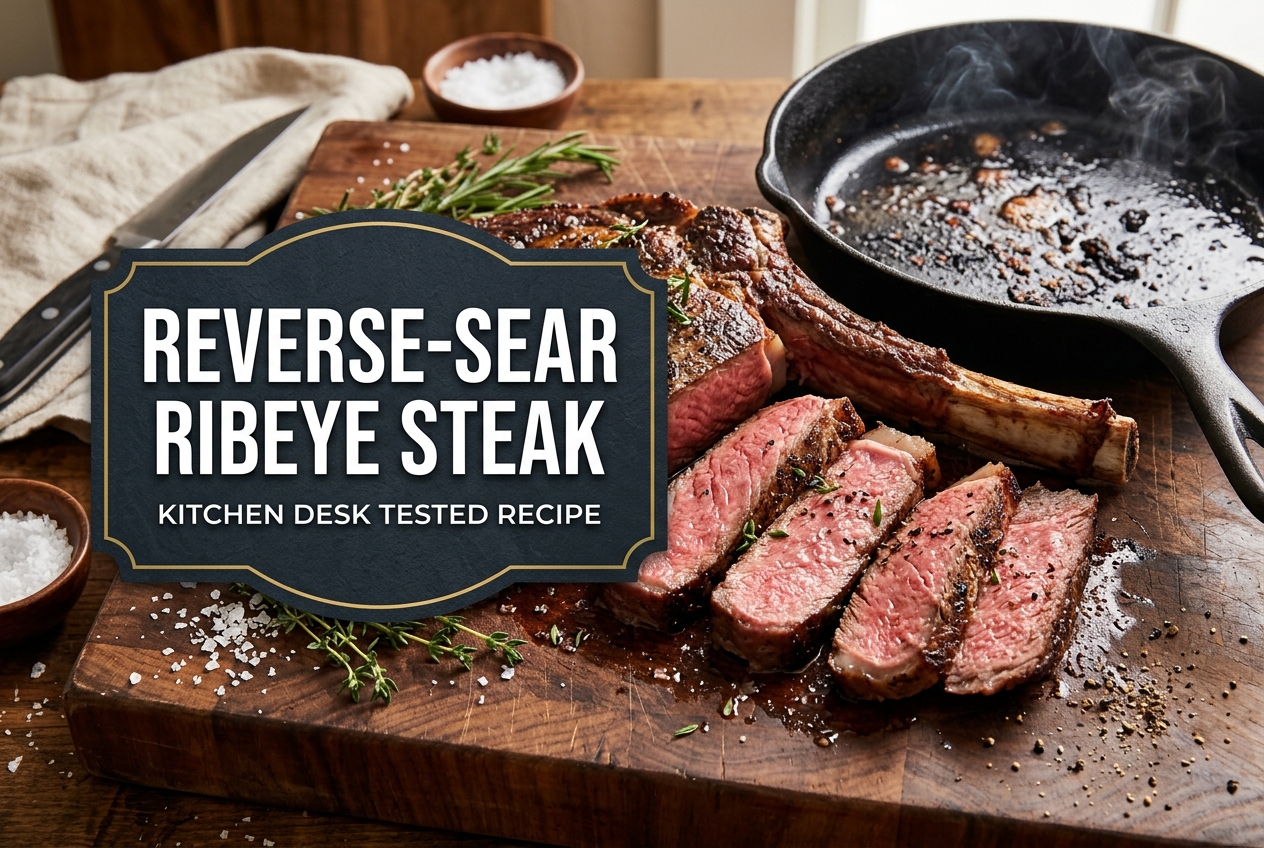
The low oven attacks the problem from the other direction. At 110°C the temperature difference between the oven air and the meat is small, so heat enters slowly and has time to distribute. By the time the core reaches 48°C, the outer layers are only a few degrees warmer — the gradient across the whole steak might be 5°C rather than 60°C. Nothing has yet entered the range where serious moisture loss occurs. The sear that follows is short enough that it browns the exterior without meaningfully heating anything beneath it, which is why a properly reverse-seared steak shows a crust perhaps two millimeters thick sitting directly on rosy medium-rare.
The oven phase does something else that is easy to overlook: it dries the surface. Browning is not a single reaction but a family of them, collectively named after Louis-Camille Maillard, in which amino acids and reducing sugars recombine into hundreds of new aromatic compounds. Those reactions require surface temperatures above roughly 140°C, and they cannot begin while liquid water is present, because evaporating water pins the surface near 100°C and consumes enormous amounts of energy in the process. A steak taken straight from the fridge to the pan spends its first minute boiling rather than browning. A steak that has spent 40 minutes in a dry oven arrives with a tacky, desiccated exterior — a pellicle — that browns almost on contact.
Dry-brining amplifies both effects and is the step home cooks skip most often. Salt applied 8 to 24 hours ahead first draws moisture to the surface by osmosis, then that salty liquid is reabsorbed as the salt dissolves and diffuses into the muscle. Along the way it partially denatures the proteins in a way that lets them hold water more effectively during cooking, which is why a dry-brined steak measurably loses less weight in the pan than an unseasoned one. Meanwhile the uncovered rest in a cold, circulating refrigerator dehydrates the exterior far more thoroughly than any amount of patting with paper towels. Salt at the moment of cooking seasons only the outside; salt a day early seasons the meat and improves its texture.
One final piece of physics governs the finish. When you pull the steak from the pan, its exterior is hundreds of degrees hotter than its core, and that stored energy keeps migrating inward — carryover cooking. In a traditionally seared steak the gradient is enormous, so carryover can add 5-8°C and the meat must rest a long time for the temperature to equalize. In a reverse-seared steak the gradient is already shallow, so carryover is modest and the rest can be short. Seven to ten minutes is enough for the muscle fibers to relax and reabsorb the juices that pressure has driven toward the center, without letting the crust you worked for turn soft.
Pull Temperatures and What Lands on the Plate
| Doneness Level | Pull From Oven | Final Rested Core | Visual Characteristics |
|---|---|---|---|
| Rare | 46°C (115°F) | 49°C - 52°C (120°F - 125°F) | Cool bright red center, extremely soft |
| Medium-Rare (Recommended) | 52°C (125°F) | 54°C - 57°C (130°F - 135°F) | Warm red center, optimal juiciness & tenderness |
| Medium | 57°C (135°F) | 60°C - 63°C (140°F - 145°F) | Warm pink center, firmer texture |
| Medium-Well | 63°C (145°F) | 66°C - 68°C (150°F - 155°F) | Slight pink center, noticeable firmness |
| Well Done | 68°C (155°F) | 71°C+ (160°F+) | Uniformly browned throughout, dry texture |
What You Need, and What You Do Not
Ingredients
Checklist- 1 Prime Bone-in or Boneless Ribeye Steak (approx. 500g / 1.5 to 2 inches thick)
- 1.5 tsp Diamond Crystal Kosher Salt (or 1 tsp fine sea salt)
- 1 tbsp High smoke point oil (Avocado or Grapeseed oil)
- 2 tbsp European Unsalted Butter (chilled)
- 3 cloves Fresh Garlic (crushed with skins left on)
- 3 sprigs Fresh Thyme or Rosemary
- 1/2 tsp Freshly cracked black Tellicherry pepper
Step-by-Step Method
- 1 Dry-Brining (Crucial Step): Season the ribeye generously on all surfaces with kosher salt. Place on an elevated wire rack inside a rimmed baking sheet. Transfer to the refrigerator uncovered for 8 to 24 hours. The salt dissolves, penetrates deeply into the meat, and draws out surface water which evaporates in the fridge.
- 2 Low & Slow Oven Baking: Preheat your oven to 110°C (225°F). Insert a digital probe thermometer into the geometric center of the steak. Place the baking sheet on the middle rack. Bake for 35 to 45 minutes until the internal core hits 48°C (118°F) for medium-rare.
- 3 Cast Iron Skillet Preheating: 10 minutes before the steak finishes baking, place a heavy cast iron skillet on high heat on the stovetop. Let it heat until lightly smoking. Add 1 tbsp avocado oil and swirl to coat the surface.
- 4 High-Heat Flash Searing: Remove the steak from the oven and immediately place it into the searing hot pan. Press down lightly with a spatula. Sear for 45 seconds on side A, then flip and sear for 45 seconds on side B.
- 5 Butter Basting (Arroser): Reduce heat to medium. Drop in the cold butter, crushed garlic, and thyme sprigs. Tilt the pan slightly so the foaming butter pools at the bottom. Use a large spoon to rapidly ladle the aromatic foaming butter continuously over the steak for 30 to 45 seconds.
- 6 Carving & Serving: Transfer steak to a warm cutting board. Rest for 7 to 10 minutes to allow muscle fibers to relax and retain juices. Slice into thick strips across the grain and garnish with flaky Maldon sea salt.
Diagnosing a Disappointing Steak
| What Went Wrong | Most Likely Cause | The Fix Next Time |
|---|---|---|
| Pale, patchy crust | Wet surface, or a pan that was hot but not smoking | Dry-brine uncovered overnight and preheat the skillet a full 8-10 minutes until it wisps smoke |
| Gray band under the crust | Sear lasted too long, or oven ran hotter than 120°C | Cap each side at 45-60 seconds and verify oven temperature with an independent probe |
| Overshot to medium-well | Pulled by time instead of by temperature, or carryover underestimated | Pull from the oven 6°C below target and remember the sear itself adds 3-5°C |
| Tough despite pink center | Steak was cut thin, or sliced with the grain | Use a 4-5cm thick cut and slice firmly across the muscle fibers |
| Bitter, acrid crust | Oil past its smoke point, or butter added while the pan was still on high | Sear in avocado or refined grapeseed oil and drop heat to medium before the butter goes in |
| Butter burned black during basting | Milk solids scorched on residual pan heat | Use cold cubed butter and keep the pan moving; the foam should be nutty tan, never dark brown |
Test Kitchen Notes
Thickness, Cut and Fuel Variations
Mash softened butter with minced roasted garlic, chopped parsley, lemon zest and a little anchovy or miso, roll it in parchment and chill. A coin melted over the resting steak seasons every slice as it dissolves. This is also the easiest way to make one steak feed a table.
After dry-brining, pat on a rub of finely ground dark coffee, unsweetened cocoa, smoked paprika and black pepper before the oven phase. The bitterness reads as savory depth rather than coffee, and the powders help build a darker crust in a shorter sear.
Bank the coals to one side, hold the steak on the cool side with the lid down until the core reaches 48°C, then sear directly over the fire. You gain smoke and lose precise control, so probe more often than you think you need to.
Replace the low oven with a 53°C water bath for 90 minutes to two hours. Dry the steak thoroughly and chill it in the fridge for 15 minutes before searing, because a bath-warm surface browns poorly and the extra moisture works against you.
What to Serve With a Reverse-Seared Steak
Ribeye is rich enough that the plate around it should cut rather than compete. Something acidic and raw does the most work: a bitter chicory salad with a sharp mustard vinaigrette, quick-pickled shallots, or simply a wedge of lemon. For a starch, choose one that welcomes the pan drippings — crushed new potatoes roasted in beef fat, a loose olive-oil mash, or thick-cut fries. Charred broccolini, blistered padrón peppers, or roasted mushrooms finished in the same skillet all sit comfortably alongside. Slice the steak across the grain into strips roughly a centimeter thick, fan them onto a warmed platter rather than individual plates, and pour any accumulated resting juices back over the top. On wine, a tannic red is the classic partner because tannin binds to fat and resets the palate between bites; Cabernet Sauvignon, Malbec, Syrah and Nebbiolo all work. A dark, malty beer or a plain sparkling water with lemon does the same job differently.
Reheating a Steak Without Cooking It Grey
Cool leftover steak to room temperature within an hour, then wrap it whole rather than sliced and refrigerate for up to three days. Slicing before storage triples the exposed surface area and dries the meat out noticeably by the next day. Reheating is where most leftover steak is ruined: do not microwave it. Instead, place the whole piece on a rack in a 90-110°C oven for 10-15 minutes until the center reaches about 45°C, then flash it in a hot dry pan for 20 seconds a side to revive the crust. That gentle warm-through is essentially a second reverse sear and it keeps the interior pink. Cold ribeye sliced thinly is also excellent on its own terms — in a sandwich with horseradish cream, over a grain bowl, or in a steak salad — so consider not reheating at all. Freezing cooked steak is possible for up to two months but the texture suffers; raw steak freezes far better if wrapped tightly and thawed overnight in the refrigerator, never on the counter.