Simmer Time and What You Actually Get
| Simmer Time | Body & Gelatin | Flavour Depth | Notes |
|---|---|---|---|
| 45 minutes | None — stays liquid when chilled | Light, clean, chicken-flavoured water | Fine for a quick soup; will not set in the fridge |
| 90 minutes | Slight viscosity | Good, but thin on the palate | The practical minimum if you are short on time |
| 2 hours | Sets softly when chilled | Full and rounded | Acceptable; noticeably better than shop-bought |
| 3 hours (Recommended) | Sets to a firm wobble | Deep, savoury, distinctly chickeny | The sweet spot — maximum gelatin before flavour degrades |
| 4-5 hours | Very firm set | Deep but starting to flatten | Diminishing returns; bones begin contributing bitterness |
| 6+ hours or any boiling | Firm but cloudy and greasy | Muddy, faintly bitter | Fat has emulsified in; clarity is unrecoverable |
Why This Broth Sets in the Fridge, and Why That Matters
The one measurable quality that separates real chicken broth from a stock cube is gelatin, and gelatin comes from collagen. Collagen is the structural protein in skin, tendons, cartilage and the connective tissue around bones, arranged as a tight triple helix that is tough and completely insoluble. Held in water above roughly 70°C for a sustained period, that helix unwinds and the strands break into shorter, water-soluble chains — gelatin. Gelatin molecules are long enough to physically interfere with water movement, which is what you perceive as body, weight and a faintly sticky richness on the lips. It also happens to be why a properly made stock sets to a wobble in the refrigerator, which is the only test you need.
This conversion is slow and depends entirely on time rather than temperature. Pushing the heat higher does not accelerate it usefully, because collagen hydrolysis is already proceeding as fast as it will at a bare simmer, and higher heat causes a different and worse set of problems. Three hours extracts most of the available gelatin from a chicken carcass; four to five hours extracts slightly more but begins to strip the meat of any remaining flavour and can turn the broth faintly bitter as bone minerals and marrow compounds accumulate. Wings, feet, backs and necks carry far more collagen per gram than breast meat, which is why a stock built from a whole bird or a bag of wings has body while one built from boneless breast is thin water no matter how long you cook it.
The reason you must never let stock boil is mechanical, not chemical. A rolling boil does two destructive things at once. It agitates the pot violently enough to shred soft proteins and fat into microscopic particles that stay suspended, permanently clouding the broth in a way no amount of straining will fix. And it emulsifies rendered chicken fat directly into the liquid, so instead of a clear broth with a fat layer you can lift off, you get a greasy, opaque, slightly flat-tasting soup. A bare simmer — a lazy bubble breaking the surface every second or two, around 85 to 95°C — extracts everything you want while leaving the fat where you can remove it.
The grey foam that rises in the first twenty minutes is worth skimming, and it is not dirt. It is albumin and other soluble blood proteins denaturing and coagulating as the temperature climbs past about 60°C, exactly the same process that makes egg white turn opaque. Left in the pot, that coagulated protein breaks apart under prolonged simmering and disperses through the liquid, contributing cloudiness and a faint muddy, livery note. Skimmed off in the first half hour with a ladle, it takes two minutes and visibly improves clarity. Starting with cold water rather than hot helps here too: proteins that rise slowly as the water heats form a cohesive raft you can lift, whereas a fast heat scatters them.
Vegetables have a much shorter useful life in stock than bones do. Onion, carrot and celery give up most of their soluble sugars, aromatic compounds and glutamates within about forty-five minutes to an hour. Beyond that they begin to disintegrate and release compounds that muddy the broth — celery in particular turns bitter over long cooking, and carrot can push the stock unpleasantly sweet. This is why the professional approach adds aromatics for the final hour rather than the first, and why the vegetables you eat in the finished soup should be fresh ones cooked briefly, not the spent ones strained out of the stock.
Noodles must be cooked separately, in plain water, and this is the single most common home-cooking error in the dish. Dried pasta releases a substantial quantity of amylose and amylopectin as it cooks, and in a pot of broth that starch clouds the liquid and thickens it into something closer to gravy. Worse, noodles do not stop absorbing liquid when they reach al dente — left sitting in broth they keep drinking it, and within an hour you have bloated, mushy noodles and noticeably less soup. Cook them separately, hold them separately, and combine in the bowl. Broth stored without noodles also freezes and reheats indefinitely better.
Key Advantages & Science
- ✓Produces a genuinely gelatinous broth that sets in the fridge — impossible to buy at this quality.
- ✓Uses the cheapest parts of the bird: wings, backs, necks and a leftover carcass.
- ✓The stock freezes for six months, so one afternoon yields many quick meals.
- ✓Almost entirely unattended — three hours of simmering needs perhaps five minutes of attention.
Important Considerations
- !Genuinely takes three hours, most of which cannot be shortened without losing the gelatin.
- !Needs a large stockpot; a standard saucepan will not hold a carcass and enough water.
- !Requires the discipline to cook noodles separately, which feels like extra washing up.
Ingredients
Checklist- 1.8kg Chicken — a whole bird, or 1kg wings plus a leftover roast carcass
- 3.5 litres Cold Water (enough to cover by 3cm, no more)
- 2 large Onions, halved with skins on, plus 1 finely diced for the soup
- 4 Carrots — 2 halved for the stock, 2 sliced 5mm for the soup
- 4 Celery Stalks — 2 broken for the stock, 2 sliced for the soup
- 1 head Garlic, halved crosswise
- 10 Black Peppercorns, 3 Bay Leaves, 6 sprigs Thyme, 6 stalks Parsley
- 200g Wide Egg Noodles or Broken Spaghetti
- 2 tbsp Unsalted Butter
- Fine sea salt to taste (roughly 2-3 tsp for the finished soup)
- Juice of half a lemon and a large handful of chopped dill or parsley to finish
Step-by-Step Method
- 1 Start Cold and Skim (30 minutes): Put the chicken in the stockpot and cover with cold water by about 3cm — no more, or you dilute everything. Bring it up slowly over medium heat, which should take 20 to 25 minutes. As grey foam gathers on the surface, ladle it off. Starting cold lets those proteins rise as a cohesive raft you can actually lift.
- 2 Settle Into a Bare Simmer (2.5 hours): Once the first bubbles break, drop the heat until the surface shows one lazy bubble every second or two. Add the halved onions with their skins, the broken celery, halved carrots, garlic, peppercorns and bay. Do not cover the pot fully — leave the lid ajar so steam escapes and never let it reach a rolling boil.
- 3 Pull the Meat Early: If you used a whole bird, lift it out at the 60-minute mark, strip the meat and return the bones and skin to the pot. Meat left in for three hours gives up everything it has and turns to tasteless fibre. Set the picked meat aside, cover, and refrigerate. Add the thyme and parsley stalks for the final 45 minutes only.
- 4 Strain and Defat (20 minutes): Strain through a fine sieve lined with muslin, pressing nothing — pressing the solids forces particles through and clouds the broth. Let it stand 20 minutes so the fat rises, then skim it off with a ladle. Chilling overnight makes this trivial: the fat sets to a solid cap you lift off in one piece. You should have about 2.5 litres.
- 5 Cook the Noodles Separately: Boil the noodles in plain salted water to just under the package time and drain. Do not cook them in the broth. Their starch will cloud and thicken it, and they will keep absorbing liquid until you have mush and no soup left.
- 6 Build the Finished Soup (15 minutes): Melt the butter in the rinsed pot, sweat the diced onion, sliced carrot and celery over medium heat for 8 to 10 minutes until softened but still holding shape. Pour in the strained broth, bring to a gentle simmer for 5 minutes, then return the reserved chicken meat and warm through for 2 minutes.
- 7 Season and Serve: Salt now, not earlier — an unsalted stock lets you reduce or reuse it freely, and it takes more salt than you expect, around 2 to 3 teaspoons. Add the lemon juice and a generous handful of dill or parsley off the heat. Put a nest of noodles in each bowl and ladle the hot soup over them at the table.
The Pot and the Skimming Tools
Diagnosing Broth and Soup Problems
| What Went Wrong | Most Likely Cause | The Fix Next Time |
|---|---|---|
| Broth stays liquid in the fridge | Not enough collagen, or simmered too briefly | Use wings, backs, necks and feet, and hold a bare simmer for a full 3 hours |
| Broth is cloudy and grey | It boiled, or the scum was never skimmed | One lazy bubble every second or two, and skim the foam in the first 30 minutes |
| Broth tastes greasy and flat | Fat emulsified into the liquid during a boil | Keep it below a simmer, then chill overnight and lift the solid fat cap off |
| Noodles turned to mush and the soup vanished | Noodles cooked or stored in the broth | Cook them separately in plain water and combine in the bowl only |
| Broth tastes bitter or muddy | Vegetables simmered the full 3 hours | Aromatics give up everything in about an hour; add delicate herbs in the last 45 minutes |
| Weak, watery flavour despite long cooking | Too much water for the amount of bone | Cover the chicken by 3cm and no more; you can always dilute a strong stock later |
Test Kitchen Notes
Storing Broth and Noodles Separately, and Why
Store the broth, the meat and the noodles separately and this soup becomes one of the best make-ahead meals there is. Strained broth keeps five days in the refrigerator, where it will set to a firm wobble, and up to six months frozen with no perceptible loss of quality. Freeze it in portion-sized containers, leaving 2cm of headspace since liquid expands, and freeze a tray of 30ml cubes as well for deglazing pans later. Picked chicken meat keeps three to four days refrigerated in an airtight container with a spoonful of broth poured over to stop it drying out, or three months frozen. Cooked noodles keep three days refrigerated, tossed in a teaspoon of oil so they do not fuse into a single mass. Assembled soup with the noodles already in it should be eaten the same day or at most the next, because the noodles keep absorbing liquid and will be swollen and soft by day two. Reheat broth on the stove to a gentle simmer rather than a boil, which keeps it clear, and warm the chicken through for only a minute or two — it is already fully cooked and further heat only toughens it. Never microwave the assembled soup on full power; it heats unevenly and turns the noodles pasty.
Noodles, Matzo Balls and Other Directions
Keep the broth exactly as written and replace the noodles with matzo balls: 1 cup matzo meal, 4 eggs, 60ml schmaltz or oil, 60ml of the broth, rested 30 minutes in the fridge, then simmered in salted water for 30 minutes covered. Cook them separately for the same starch reason, and use schmaltz skimmed from your own stock for the best version.
Cook 150g of orzo separately, then temper 3 egg yolks with the juice of two lemons and slowly whisk in two ladles of hot broth before returning the mixture to the pot off the heat. It thickens into something silky and tart. Never let it boil afterwards or the yolks will scramble.
Add a 5cm piece of sliced ginger, two star anise and a cinnamon stick for the last hour, and finish with fish sauce instead of salt plus sliced spring onion, coriander and chilli. Serve over rice noodles rather than egg noodles. Effectively a lighter, faster route to something in the phở family.
Replace the noodles with 200g of cooked wild rice and stir 150ml of double cream plus 2 tablespoons of flour cooked into the butter as a roux before adding the broth. Considerably heavier and closer to a chowder — add the cream off the heat and do not let it boil, or it can split against the broth's acidity.
What to Serve With It
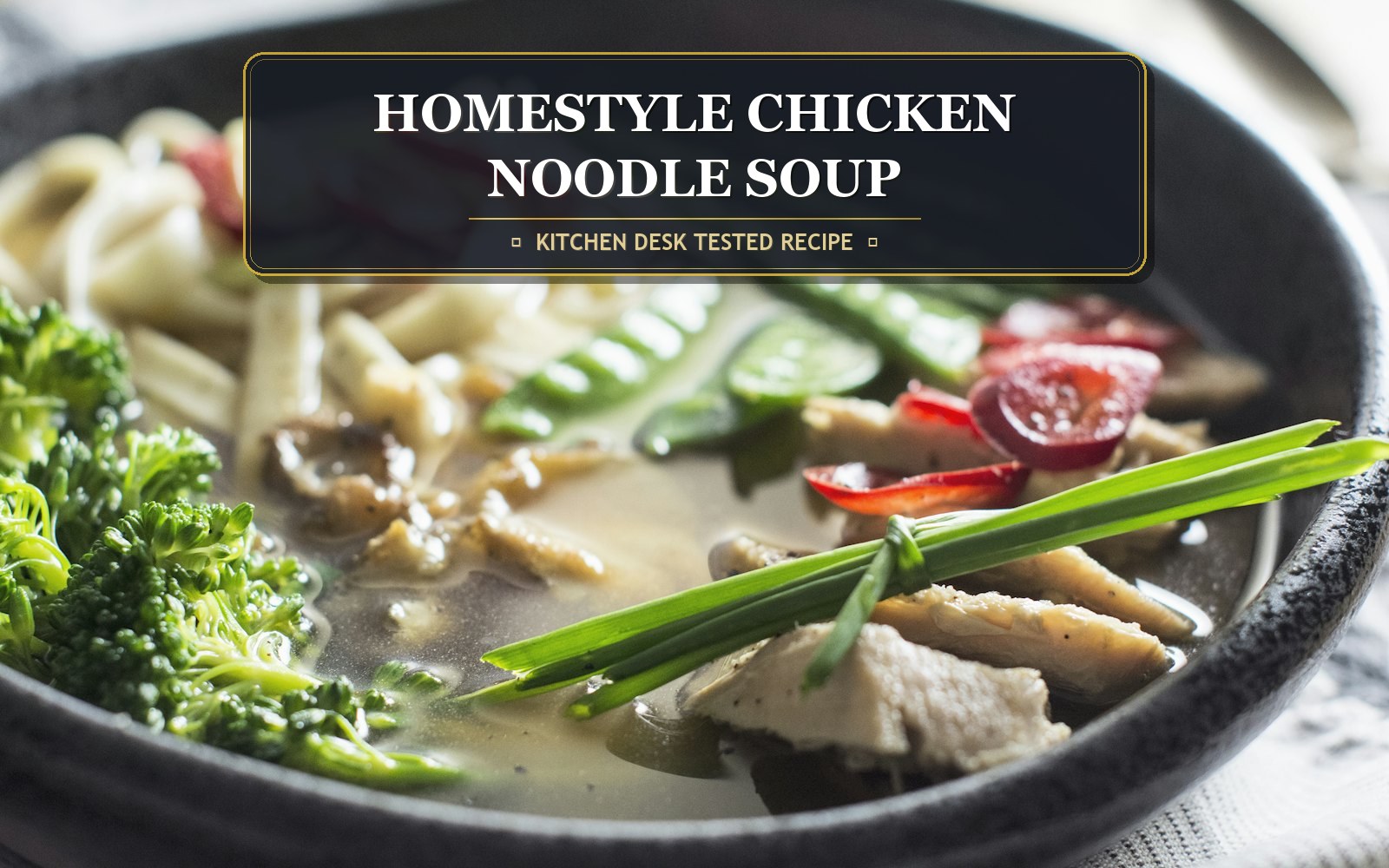
Chicken noodle soup is best served in wide shallow bowls rather than deep ones, which keeps the noodles and vegetables visible and lets the surface cool to an edible temperature within a minute or two. Assemble at the table: a nest of noodles in each bowl, then hot broth ladled over, then a final scatter of dill or parsley and a crack of black pepper. This order matters, because it is the only way the noodles reach the eater without having sat in liquid. Bread should be plain and sturdy — a crusty white loaf, a good sourdough, or soda bread, torn rather than sliced and served with cold butter. Saltines and oyster crackers are the traditional American accompaniment and are genuinely good for the textural contrast. Keep everything else on the table simple and sharp: quick-pickled cucumbers, a crisp green salad with a lemon dressing, or nothing at all. Bottled hot sauce and extra lemon wedges on the side let people adjust their own bowls, which is worth doing since seasoning preferences for soup vary more than for almost any other dish. Drinks should not compete — water, tea, or a dry cider. If you want wine, an unoaked white with real acidity such as Chablis or Grüner Veltliner suits it better than anything rich.