What Each Chopping Method Does to the Herbs
| Preparation Technique | Cellular Impact | Enzyme Release | Visual Appearance | Flavor Profile |
|---|---|---|---|---|
| Hand Knife Chop (Sharp) | Clean cell slice | Low PPO oxidation | Vibrant emerald green bits | Crisp, peppery, clean herbs |
| Dull Knife Crushing | Crushed cell walls | Moderate oxidation | Dark olive green weeping | Slightly bitter and muted |
| Food Processor Pulse | Torn cell fragments | High PPO oxidation | Muddy green slurry | Grassy and swampy bitterness |
| High-Speed Puree | Completely homogenized | Maximal oxidation & heat | Brownish emulsion | Unpalatable bitter paste |
| Mortar and Pestle (Pounded) | Crushed, unevenly broken cells | Moderate to high oxidation | Dark green and pale patches | Rustic and intense, best for garlic and oregano |
| Fine Knife Mince (1mm) | Many clean cuts, a few tears | Moderate oxidation | Even but duller green | Sharper and more uniform, softer texture |
Why Chimichurri Is Chopped, Rested and Never Cooked
Chimichurri is a chopped sauce, not a blended one, and the difference is not only texture. Running the herbs through a food processor tears the cells open indiscriminately and warms them while it does it. The moment a parsley cell is torn, an enzyme called polyphenol oxidase, which normally sits in a separate compartment, meets the chlorophyll and the phenolic compounds it reacts with, and the result is the dull olive-brown colour of herb paste that has been left standing. The blades also beat the oil into the herb water, so instead of a spoonable sauce with visible flecks you get a thick green sludge that coats everything it touches. A sharp knife cuts fewer cells, generates no friction heat, and leaves uneven pieces, some fine and some larger. That unevenness is what makes the sauce read on the plate and taste of herbs rather than of green.
Garlic is the one ingredient that can ruin chimichurri, and the difference between good and harsh is entirely in how you cut it and when it meets the vinegar. Intact garlic holds an amino acid called alliin and a separate enzyme, alliinase, in different compartments. Break the cells and the two combine to form allicin, the compound behind raw garlic's burn, and the more cells you break, the more allicin you make. That is why pressed or microplaned garlic is far more aggressive than a chop. Chop it into small even bits with a knife instead. Then leave it alone in the red wine vinegar for ten to fifteen minutes before the oil goes anywhere near it. The acid slows the enzyme and softens allicin's edge, and what survives is rounder and more savoury. Skip that rest and the garlic tastes raw and hot for hours.
Argentinian chimichurri is parsley-led, and that is a deliberate choice rather than a matter of what grows locally. Flat-leaf parsley is grassy, faintly bitter, and low in the soapy-tasting aldehydes that make cilantro so divisive. A substantial share of people carry a variation in a smell receptor gene that makes cilantro read as soap or metal, and building a national sauce on an ingredient a good number of your guests cannot taste properly would be an odd thing to do. Parsley also holds its colour and its structure in acid and oil, where cilantro softens and darkens faster. Cilantro chimichurri exists and it is good, but it is closer to a South American salsa verde than to the sauce served with asado. If you use cilantro, use it the day you make it and treat parsley as the default this recipe assumes.
The vinegar is red wine vinegar and the oil should be a mild one. This is not the place for the expensive peppery oil you keep for finishing. Chimichurri is a raw sauce, so every ingredient in it tastes of itself at full volume, and a strong, bitter, peppery olive oil will flatten the parsley and the oregano under its own flavour instead of carrying them. A soft, buttery extra virgin or a plain light olive oil disappears into the background where it belongs. If the only oil you have is a robust one, use half of it and half a neutral oil such as sunflower; the sauce loses nothing and gains balance. Red wine vinegar is traditional for the same reason: sharp and grapey, without the sweetness of balsamic or the thin, chemical edge of distilled white.
Dried oregano earns its place over fresh here, which is not true of most herbs. Drying concentrates the phenolic compounds thymol and carvacrol that give oregano its warm, faintly medicinal depth, and in a cold sauce that intensity is exactly what you want. Fresh oregano leaves are softer and more floral, and in a raw sauce they mostly taste green. Dried leaves are stiff and papery, though. Tip them straight into oil and they stay gritty and never fully give up their flavour. Two tablespoons of warm water poured over the oregano and left for five minutes rehydrates the fragments and begins to dissolve those fat-soluble compounds, so they disperse evenly through the finished sauce instead of sitting in dry specks. The soaking water goes into the bowl too, because it carries most of the flavour.
Chimichurri is a suspension, not an emulsion, and the difference explains the one thing that always happens to it. An emulsion, like mayonnaise, is held together by an emulsifier that keeps droplets of one liquid dispersed through another. Nothing in chimichurri is doing that job. Vinegar and oil do not mix, and the herb fragments are simply held up by their own bulk. Leave the bowl on the counter and within twenty minutes it settles into a clear oil layer on top and a dense dark layer of vinegar and herbs underneath. That is normal rather than a fault. Stir it up from the bottom with a fork and it comes back together in a few seconds. Shaking a jar works too, but gently, because hard shaking whips in air and bruises the herbs.
Chimichurri is made two to twenty-four hours ahead and the rest is not optional. In the first couple of hours the salt dissolves, the vinegar works its way into the chopped herbs and the garlic, and the oil draws the fat-soluble aromatics out of the parsley and the oregano. At minute zero the sauce tastes sharp, astringent and raw; at hour eight it tastes like a finished sauce. Past about a day the parsley starts to lose its colour and the vinegar begins to dominate, so this is a window rather than a rule that longer is better. What chimichurri never gets is heat. Cooking it destroys the volatiles you spent the rest extracting, darkens the herbs and turns the sauce bitter. It is a sauce for the table, spooned over hot meat on the plate and never into the pan.
Ingredients
Checklist- 1 large bunch Fresh Italian Flat-Leaf Parsley (approx. 1 cup finely chopped, packed)
- 4 cloves Fresh Garlic, minced paper-fine
- 1 tbsp Dried Oregano (bloomed in 2 tbsp warm water for 5 minutes)
- 1/2 cup (120ml) Extra Virgin Olive Oil (fruity, medium-intensity)
- 1/4 cup (60ml) Good-Quality Red Wine Vinegar
- 1 tsp Crushed Red Chili Flakes (or 1 fresh red Fresno chili, finely minced)
- 1 tsp Flaky Kosher Sea Salt
- 1/2 tsp Freshly cracked black pepper
Step-by-Step Method
- 1 Bloom the Dried Oregano. In a small bowl, combine 1 tbsp dried oregano with 2 tbsp warm water. Let sit for 5 minutes. This awakens concentrated carvacrol essential oils and rehydrates the leaves.
- 2 Wash and Thoroughly Dry Parsley. Wash flat-leaf parsley and spin in a salad spinner. Pat completely dry with towels; water on herb leaves prevents olive oil adherence and causes rapid browning.
- 3 Hand-Mince with a Sharp Knife. Strip leaves from thick stems (tender upper stems are fine). Using a razor-sharp chef knife, slice cleanly through the bunch once, then chop into fine, distinct flakes. Do not repeatedly run the knife back and forth over the herbs like a puree.
- 4 Finely Mince the Garlic. Mince garlic cloves into tiny, uniform bits. Avoid grating on a microplane; grated garlic produces harsh, acrid allicin paste that overwhelms the herbs.
- 5 Combine Ingredients in Glass. In a glass bowl or jar, combine chopped parsley, minced garlic, bloomed oregano with its liquid, red chili flakes, kosher salt, and black pepper.
- 6 Pour Vinegar and Olive Oil. Add red wine vinegar first and toss to coat herbs in acid. Pour in extra virgin olive oil and stir gently with a fork until herbs are suspended evenly.
- 7 Rest and Macerate. Cover and let rest at room temperature for at least 2 hours before serving. This allows salt to dissolve, acid to mellow garlic bite, and oil to absorb herb aromatics.
Key Advantages & Science
- ✓Zero cooking required — comes together in 15 minutes of knife work.
- ✓Cuts through rich fatty steaks, sausages, and pork with lively acidity.
- ✓Improves significantly in flavor depth over 24 hours of cold marination.
- ✓Vibrant emerald green presentation elevates any grilled protein.
Important Considerations
- !Requires fine hand-chopping; food processors ruin texture and color.
- !Olive oil solidifies in refrigerator temperatures (requires 15 mins tempering).
- !Must use flat-leaf Italian parsley (curly parsley has a bitter, dry texture).
The Knife, the Board and the Jar
Test Kitchen Notes
Chimichurri Problems and Their Causes
| What Went Wrong | Most Likely Cause | The Fix Next Time |
|---|---|---|
| Sauce turned muddy dark brown | A food processor or a dull knife bruised the herbs and released oxidising enzymes | Hand-chop with a sharp knife and add the vinegar before the oil so the acid slows the browning |
| Garlic tastes harsh and burns at the back of the throat | Garlic was pressed into a paste, or the sauce was eaten straight after mixing | Chop rather than press, and let the garlic sit in the vinegar 10-15 minutes before the oil goes in |
| Oil solidified in the refrigerator | Olive oil's saturated fat crystallises below about 10°C (50°F) | Stand the jar at room temperature for 15-20 minutes and stir; never microwave it, which cooks the herbs |
| Sauce tastes flat and simply oily | Under-salted, or it was served before the herbs had time to infuse | Rest a full 2-24 hours and salt after resting, tasting a spoonful that carries both oil and herbs |
| Liquid pools on top and the herbs sink | Parsley was not dried properly, so water went into the jar with it | Dry the leaves thoroughly before chopping, stir from the bottom before each serving, and use within two days |
| Sauce tastes aggressively vinegary | Too much vinegar for the amount of herb, or the sauce sat for more than a day | Add another handful of chopped parsley and a tablespoon of oil, and keep inside the 2-24 hour window |
| Bitter rather than fresh herb flavour | Thick woody stems went in, or the oil used was a bitter, peppery finishing oil | Strip the lower stems and use a soft, mild olive oil; robust oils flatten parsley instead of carrying it |
Red Chimichurri, Cilantro and Other Directions
Add a tablespoon of smoked sweet paprika and two tablespoons of roasted red pepper puree to the base. The sauce turns a deep brick red and picks up a sweet, smoky edge that suits pork and chicken better than it suits beef. Drop the oregano to two teaspoons so the paprika is not buried under it, and give it the full rest, because the pepper puree needs time to settle into the oil.
Swap the parsley for cilantro and add the finely grated zest of half a lime with one minced green chilli. This lands closer to a South American salsa verde than to Argentinian chimichurri, and it is much better on the day it is made, since cilantro darkens and softens faster than parsley does. Excellent on grilled fish, prawns and chicken.
Roast a whole head of garlic at 200°C (400°F) for 35 minutes until the cloves are soft, then squeeze them out and mash them into the vinegar in place of the raw garlic. The sauce loses its raw bite and gains a deep sweetness, and it keeps longer without the allicin turning harsh after a few days. This is the version to make for anyone who finds raw garlic overwhelming, and it is very good on roast chicken.
Blister two Fresno chillies directly over a flame or under a hot grill until the skins blacken, then peel, deseed and chop them into the sauce in place of the flakes. The charred flesh adds a smoky, fruity heat and a little extra body. Wear gloves while handling them, and note that the heat creeps up overnight as the capsaicin works its way into the oil.
What to Serve With Chimichurri
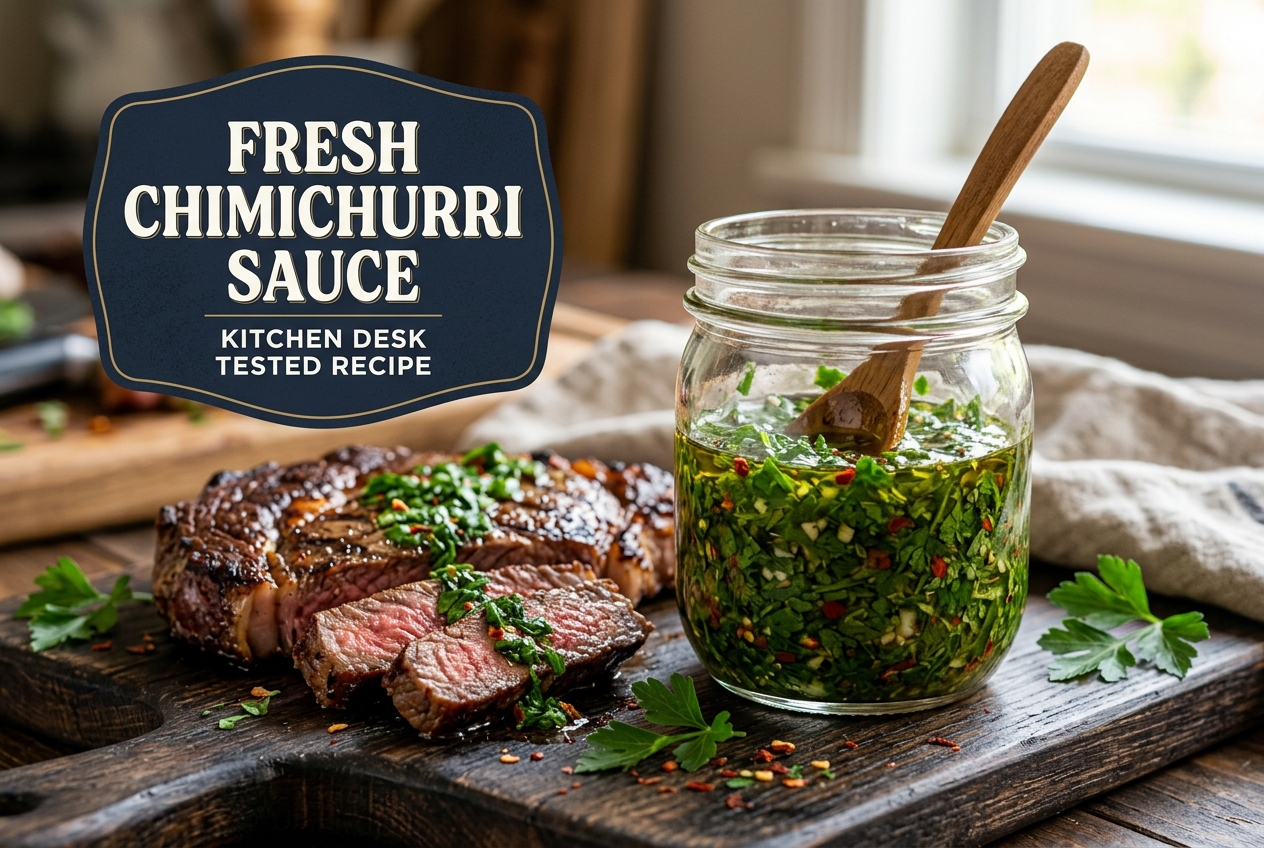
Chimichurri belongs on the table in a small bowl with a spoon in it, not drizzled over the meat in the kitchen. It is a condiment for grilled meat, and in Argentina it sits beside the parrilla with bread and a plain tomato and onion salad. Spoon it over sliced skirt steak, flank, ribeye, hanger steak, grilled sausage, chicken thighs or lamb chops, and let people add more themselves. It is just as good on charred vegetables, courgette, aubergine, peppers, spring onions, and on grilled fish, though the vinegar will overpower anything as delicate as sole. It also works on fried eggs, stirred into white beans, spooned over roast potatoes, or loosened with a little more oil and used as a dressing for tomato salad. Serve it at room temperature, because straight from the fridge the oil is set and the flavours are shut down. Keep good bread nearby, since the oil left on the plate is the best part. To drink, a Malbec, a chilled light red or a dry rosé.
Why the Oil Sets in the Fridge, and What It Means
Store in a sealed glass mason jar in the refrigerator for up to 2 weeks. The oil layer on top preserves the herbs.