Why the Whites and Yolks Need Different Treatment
The central difficulty of shakshuka is that an egg is two foods with different setting points cooked in one vessel. Egg white is mostly ovalbumin and related proteins that begin to coagulate around 62 to 65°C, turning from clear liquid to opaque solid. Yolk proteins hold out longer, staying fluid until roughly 65°C and only setting firm near 70°C. That gives you a window of perhaps five degrees in which the white is fully set and the yolk is still liquid. Poached in water the problem barely exists because the water surrounds the egg evenly, but nestled in a pan of sauce the egg has hot sauce beneath and cool air above, so left uncovered the base of the white and the underside of the yolk overcook long before the top of the white stops being slimy.
The solution is to change the direction the heat arrives from. Covering the pan traps steam, and steam condensing on the surface of the egg transfers heat very efficiently — condensation releases a large amount of latent energy at exactly 100°C, which is why a covered pan sets the top of the white in two minutes when an uncovered one takes six. Meanwhile the burner underneath can be turned down to almost nothing, because the sauce has enormous thermal mass and holds temperature well. You end up cooking the whites from above and the yolks barely at all, which is precisely the asymmetry you need.
The sauce has to be thick before the eggs go in, and this is structural rather than aesthetic. A well pressed into a loose, watery sauce collapses immediately and the egg white disperses into the tomato in thin threads rather than staying as a defined poached egg. Reducing the sauce until a spoon dragged across the pan leaves a channel that holds for a second or two gives you walls that support the egg. Reduction also concentrates flavour, since roughly a third of the water in canned tomatoes has to leave for the sugars, acids and glutamates to reach the intensity the dish needs.
Canned tomatoes genuinely outperform fresh ones here for most of the year, and it is not a compromise. Tomatoes destined for canning are harvested at full ripeness and processed within hours, whereas fresh supermarket tomatoes are picked firm and under-ripe to survive transport, which means their sugars and glutamates never fully developed. Canning also involves brief heating, which ruptures cell walls and makes lycopene and glutamate more available. Whole peeled tomatoes crushed by hand are better than pre-chopped, because chopped tomatoes are usually treated with calcium chloride to help them hold their shape, and that firmness works against you when you want them to break down into sauce.
The spices need fat and heat, applied briefly. Cumin's dominant aroma compound, cuminaldehyde, and paprika's colour and flavour compounds are fat-soluble rather than water-soluble, so tipping them into a wet tomato base extracts very little. Adding them to the hot oil with the softened onions and peppers for thirty to sixty seconds — the technique called blooming — dissolves those compounds into the fat, which then distributes them through the entire dish. The window is short. Ground spices in hot oil scorch in well under two minutes, and paprika in particular is high in sugar and burns fast, turning harsh and bitter with no way back.
Onions and peppers should be cooked far longer than most recipes suggest. Both are high in water and in fructose and glucose, and a genuine ten to twelve minutes over medium-low heat does two things: it drives off enough water that the pan can finally climb past 100°C, and it lets those sugars caramelise into deep, sweet, rounded flavour. Rushed for four minutes, they contribute raw vegetal sharpness instead, which is the difference between a shakshuka that tastes flat and one that tastes slow-cooked. Salting them early helps here, because the drawn-out water evaporates and speeds the whole process along.
Egg Doneness by Covered Cooking Time
| Lid Time (low heat) | Egg White | Egg Yolk | Best For |
|---|---|---|---|
| 4 minutes | Just barely set, some clear patches | Completely liquid | Too underdone for most; whites read as slimy |
| 5-6 minutes (Recommended) | Fully opaque and set | Warm and fully runny | The classic result — yolk runs when pierced |
| 7-8 minutes | Firm | Thick and jammy, does not run | Serving to children, or eating with a fork not bread |
| 9-10 minutes | Firm, slightly rubbery at the base | Fully set but still bright | Meal prep, or if you dislike loose yolk |
| 11-12 minutes | Rubbery | Pale, crumbly, chalky | Overcooked — the sulphurous note starts here |
| Uncovered, any time | Slimy on top, tough underneath | Overcooked from below | Avoid; the lid is not optional |
Ingredients
Checklist- 6-8 Large Eggs, at room temperature
- 1 x 800g tin Whole Peeled Plum Tomatoes, crushed by hand
- 2 Red Bell Peppers, cut into 1cm dice
- 1 large Onion, finely diced
- 4 cloves Garlic, thinly sliced
- 2 tsp Ground Cumin (or 2 tsp whole seeds, toasted and ground)
- 2 tsp Sweet Paprika plus 1/2 tsp Smoked Paprika
- 1/2 tsp Chilli Flakes or 1 fresh red chilli, sliced
- 1 tsp Caster Sugar and 1 tsp Fine Sea Salt
- 3 tbsp Olive Oil
- 120g Feta, crumbled, plus fresh coriander or parsley to finish
Step-by-Step Method
- 1 Toast and Grind the Spices (optional, 3 minutes): Warm the whole cumin seeds in a dry pan over medium heat for 60 to 90 seconds until fragrant and a shade darker, then grind. This releases far more aroma than pre-ground cumin, which has usually lost most of its volatile oils to the jar.
- 2 Build the Base Slowly (12 minutes): Heat the olive oil in the skillet over medium-low. Add the onion and peppers with the teaspoon of salt and cook, stirring occasionally, for a full 10 to 12 minutes until genuinely soft, sweet and beginning to catch gold at the edges. This is the step people rush and it is where most of the flavour comes from.
- 3 Bloom the Spices (1 minute): Add the garlic, cumin, both paprikas and the chilli. Stir constantly for 45 to 60 seconds until the oil turns deep red and the kitchen smells strongly of spice. Do not exceed a minute — paprika is high in sugar and scorches into bitterness quickly.
- 4 Add and Reduce the Tomatoes (18 minutes): Crush the tomatoes into the pan with your hands, add the sugar, and stir. Bring to a lively simmer and cook, stirring now and then, for 15 to 20 minutes. You are done when a spoon dragged across the base leaves a channel that holds its shape for a second or two. A loose sauce cannot support the eggs.
- 5 Make the Wells: Taste and adjust salt now, because you cannot stir once the eggs are in. Drop the heat to low. Use the back of a spoon to press six to eight deep wells into the sauce, spacing them evenly and pushing almost to the pan base so each well has real walls.
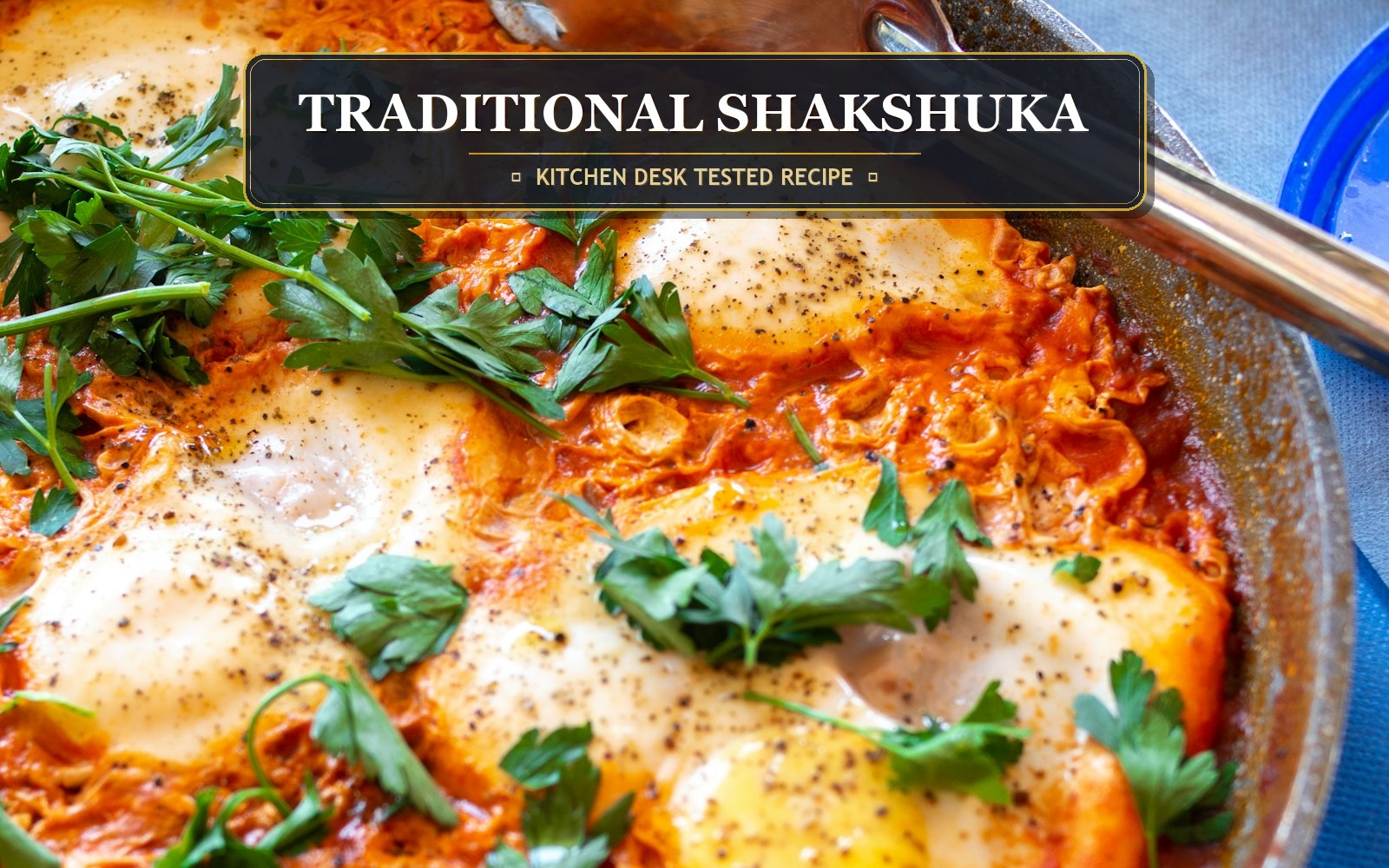
- 6 Add the Eggs and Cover: Crack each egg into a small cup and slide it into a well rather than cracking directly over the hot pan — this keeps the yolks intact and lets you place them precisely. Season the tops lightly with salt and pepper. Cover the pan tightly and cook 5 to 6 minutes on low.
- 7 Check and Finish: Lift the lid at 5 minutes. The whites should be uniformly opaque with no clear patches, and the yolks should still wobble visibly when you shake the pan. Scatter over the feta and herbs, drizzle with olive oil, and rest 5 minutes off the heat before serving straight from the pan — residual heat continues setting the whites slightly.
The Pan, the Lid and the Spoon
Diagnosing Shakshuka Problems
| What Went Wrong | Most Likely Cause | The Fix Next Time |
|---|---|---|
| Whites still clear while yolks are hard | Pan cooked uncovered, so heat only came from below | Cover the pan — condensing steam sets the whites from above while the yolks stay cool |
| Egg whites dispersed into the sauce | Sauce was too loose to hold a well | Reduce until a spoon leaves a channel that holds for a second or two before adding eggs |
| Sauce tastes sharp and raw | Onions and peppers undercooked | Give them a genuine 10-12 minutes over medium-low until sweet and starting to colour |
| Bitter, harsh spice flavour | Paprika scorched in the oil | Bloom the spices for 45-60 seconds only; paprika's sugars burn fast |
| Watery liquid pooling around the eggs | Tomatoes not reduced enough, or lid condensation dripping back in | Reduce longer, and tilt the lid slightly or wipe it dry halfway through |
| Yolks overcooked before whites set | Heat too high, so the base cooked faster than the steam | Drop to genuinely low heat once the eggs go in; the sauce holds plenty of residual heat |
Test Kitchen Notes
Green Shakshuka, Merguez and Other Directions
Replace the tomatoes entirely with 400g of spinach or chard wilted down with leeks, courgette and plenty of garlic, loosened with 150ml of stock and finished with lemon zest. Swap the cumin and paprika for coriander seed and a little cardamom. Much lighter, and the wells need care because greens hold less structure than reduced tomato.
Brown 300g of merguez or spicy lamb sausage in the pan first, remove it, and build the sauce in the rendered fat. Return the sausage before making the wells. Cut the added salt in half — cured sausage brings a great deal — and expect a noticeably heavier, dinner-weight dish.
Stir 2 tablespoons of rose harissa in with the spices and add a drained 400g tin of chickpeas with the tomatoes. The chickpeas absorb sauce and make it a genuinely substantial one-pan meal. Add 60ml of water with them, since they drink more liquid than you expect during the reduction.
Skip the wells entirely. Once the sauce has reduced, beat the eggs loosely and stir them through over low heat, scrambling until just set in soft curds — closer to a folded omelette suspended in tomato. Traditionally made with long green peppers rather than bell peppers and finished with a great deal of butter.
Bread, and What Else Belongs on the Table
Shakshuka should arrive at the table in the pan it was cooked in, set on a board or trivet, with everyone eating from the middle. This is not presentation for its own sake — the cast iron keeps it hot for the full twenty minutes it takes to finish, and plating it individually loses both the heat and the point. Bread is the essential accompaniment and it should be something sturdy enough to scoop: warm pita, thick flatbread, challah, or good sourdough torn rather than sliced. Cutlery is optional and traditionally unnecessary. Around it, the natural companions come from the same table: labneh or thick Greek yoghurt drizzled with olive oil, a chopped salad of cucumber, tomato and mint dressed with lemon, quick-pickled red onions, olives, and a bowl of good hummus or muhammara. Zhoug or a spoonful of harissa on the side lets people adjust the heat themselves. Because the dish is rich, acidic and spiced, drinks should be simple — mint tea, strong black coffee, fresh orange juice, or ayran and other salted yoghurt drinks if you want the traditional pairing. If you are serving it as dinner rather than breakfast, a dry rosé or a chilled light red like Frappato works better than white.