What Goes Into the Pan, and in What Order
| Ingredient | Stage | Optimal Fat Medium | Culinary Function |
|---|---|---|---|
| Whole Spices (Cardamom, Cloves) | Initial 60 sec | Ghee / Mustard Oil | Releases heavy volatile base notes |
| Ginger-Garlic Paste | Medium Heat (2 min) | Warm Ghee | Cooks out raw sulfur compounds into sweet alliums |
| Kashmiri Chili Powder | Low Heat (30 sec) | Mild Ghee | Extracts vibrant natural red carotenoid pigments |
| Kasuri Methi (Fenugreek) | Final 60 sec off heat | Warm Gravy / Butter | Preserves delicate bitter maple aromatic volatiles |
| Cold Cubed Butter | Off heat, last 2 min | Warm gravy, no direct heat | Milk proteins and phospholipids re-emulsify butterfat into a glossy finish |
| Heavy Cream | Off heat, after the butter | Warm gravy, below a simmer | Adds butterfat and body; its casein curdles if boiled in an acidic sauce |
Why Butter Chicken Is Cooked Twice, and Why the Cream Waits
Chicken thighs go into a marinade of yogurt, lemon juice, salt and spices, and it helps to know which part is doing what. The salt matters most. It dissolves into the surface moisture, then diffuses inward over several hours, partially unfolding the muscle proteins so they hold on to water instead of squeezing it out over heat. The lemon juice and the lactic acid in the yogurt acidify the surface, denaturing the outermost proteins quickly, which is why a long-marinated piece of chicken looks slightly opaque and firm at the edges before it ever sees a pan. What none of it does is travel far. Acid and yogurt reach a few millimetres in the time you have. So the tenderising everyone credits to the yogurt is mostly the salt, and mostly the fact that you chose thigh meat.
Four hours is the stated minimum and twelve is better, because diffusion is slow and roughly linear in time. Salt needs hours at refrigerator temperature to move even a centimetre into a piece of chicken. Under two hours you are seasoning the surface and nothing else, which is why a rushed marinade tastes fine on the outside and thin within. The upper limit is set by the acid rather than the salt. Leave chicken in an acidic marinade for two or three days and those surface proteins stay denatured and lose their grip on water, so the exterior turns chalky, mealy and slightly grey. No amount of gravy hides that. The yogurt matters for a different reason: it is thick enough to stay coated on the meat, so the salt and the spices sit against the surface for the whole twelve hours instead of sliding into the bowl. Four to twelve hours is the working window, and a full day is the outside edge of it.
Butter chicken is cooked twice, and both stages matter. The chicken is not simmered from raw in the gravy. It is cooked first over direct, fierce heat, in a tandoor traditionally and on cast iron or under a hot broiler at home, four to five minutes a side. That first stage is where most of the flavour is made. Surface temperature climbs well past 140°C (285°F), and the Maillard reaction between amino acids and sugars builds the browned, roasted notes you cannot get from a wet sauce, which will not exceed 100°C (212°F) however hard you boil it. The second stage is the opposite: the charred pieces go into the gravy and finish gently for eight to ten minutes. Pull them from the first stage while still slightly underdone at the centre and the braise finishes the job without drying them out.
Whole spices and Kashmiri chilli need fat, not water. The aromatic compounds in cardamom, clove and cinnamon, and the pigments that make Kashmiri chilli red rather than merely hot, are fat-soluble. Dropped into a tomato base they mostly stay locked inside the spice particles and never reach your tongue. Heated in ghee for a minute they dissolve into the fat, and that fat then carries them through the whole pot. The order is not fussiness either. Whole spices need the full sixty seconds to open up. Ginger and garlic need about two minutes over medium heat to cook out the raw, sulfurous edge and turn sweet. Ground Kashmiri chilli needs thirty seconds and no more, because its sugars scorch quickly and bitter chilli powder is a one-way trip. If the pan looks dry at any point, add another spoonful of ghee rather than a splash of water; the aromatics need fat to dissolve into, and water only washes them away from the meat.
Blending and straining are two separate steps, and the second is the one people skip. A twenty-minute simmer breaks tomatoes down but does not destroy the cellulose of the skins or the hard coats of the seeds; both survive into the finished sauce as grit. A high-speed blender shatters most of them, which is why you run it a full two minutes rather than thirty seconds, but it also whips air in and leaves fibrous fragments still large enough to feel on your tongue. Pushing the purée through a fine mesh sieve takes them out, along with stray whole spices and the last of the cashew skins. That single pass is most of the distance between a decent home curry and a restaurant one. Press it through with the back of a ladle rather than grinding at it; you want the liquid, not the solids.
Cream goes in off the heat for a reason you can see the moment it goes wrong. Cream is an emulsion of butterfat droplets held in water by milk proteins, and the proteins are the fragile part. Heat them hard and they unfold and bond to each other. Add acid, and a tomato gravy is genuinely acidic, and they clump at a lower temperature still, because the acid pushes casein toward the pH where it carries no net charge to keep the molecules apart. Those two conditions arrive together in a boiling tomato-and-cream sauce, which is exactly how a gravy turns grainy and starts leaking fat at the edges of the pan. Stir the cream in with the pot off the burner, let residual heat warm it through, and only then return it to a bare simmer if you must. Never let it boil once the dairy is in.
Kasuri methi is dried fenugreek leaf, and it is the ingredient that makes butter chicken taste like butter chicken rather than like a tomato curry. Its characteristic aroma comes largely from sotolon, the same compound behind the maple note in fenugreek and in a good vin jaune: sweet, faintly bitter, almost caramel-like, and instantly recognisable as restaurant butter chicken to anyone who has eaten the dish before. Sotolon is fat-soluble and volatile, so two habits matter. Crush the leaves between your palms first, which ruptures the cells and releases what is inside, and add them at the very end, off the heat, so the aromatics stay in the sauce instead of leaving in the steam. Dried fenugreek seed is not a substitute. It is bitter and hard and tastes of curry powder. There is no real stand-in.
Ingredients
Checklist- 750g (1.6 lbs) Boneless Skinless Chicken Thighs, cut into 1.5-inch pieces
- For Marinade: 1/2 cup Greek Yogurt, 1 tbsp Ginger-Garlic paste, 1 tbsp Lemon juice, 1 tbsp Kashmiri chili powder, 1 tsp Garam masala, 1 tsp Salt, 1 tbsp Mustard oil
- For Gravy: 800g (28 oz) Whole Canned San Marzano or Ripe Plum Tomatoes
- 50g (1/3 cup) Raw Cashews, soaked in hot water for 20 minutes
- 4 tbsp Ghee (clarified butter), divided
- 60g (4 tbsp) Cold European Unsalted Butter, cubed
- 1/2 cup Heavy Cream
- 1 tbsp Ginger-Garlic paste
- 4 Green Cardamom pods, 2 Cloves, 1 small Cinnamon stick
- 1 tbsp Dried Fenugreek Leaves (Kasuri Methi), crushed between palms
- 1 tsp Sugar or Honey (to balance tomato acidity)
- 1 tsp Garam Masala and 1 tsp Kashmiri chili powder
Step-by-Step Method
- 1 Marinate the Chicken. Combine yogurt, ginger-garlic paste, lemon juice, mustard oil, Kashmiri chili, garam masala, and salt. Coat chicken pieces thoroughly. Cover and refrigerate for 4 to 12 hours.
- 2 High-Heat Char the Chicken. Preheat oven broiler to High or get a smoking cast iron skillet hot with 1 tbsp ghee. Cook chicken for 4-5 minutes per side until charred on the edges but slightly underdone in center. Set aside.
- 3 Simmer Gravy Aromatics. In a Dutch oven, heat 2 tbsp ghee. Add whole cardamom, cloves, and cinnamon. Sauté 60 seconds until fragrant. Add ginger-garlic paste and cook 1 minute until sweet.
- 4 Cook Tomatoes and Cashews. Add crushed tomatoes, soaked cashews, 1 tsp Kashmiri chili, and 1/2 cup water. Simmer on medium-low for 20 minutes until tomatoes collapse and oil begins separating.
- 5 Blend and Strain to Silk. Remove whole cinnamon stick. Transfer tomato-cashew mixture to high-speed blender and blend on high for 2 minutes until completely smooth. Pour through a fine mesh strainer directly back into the pot.
- 6 Simmer with Chicken and Butter. Add charred chicken and resting juices into the strained sauce. Simmer gently on low for 8-10 minutes until chicken is cooked through. Stir in sugar and heavy cream.
- 7 The Cold Butter and Fenugreek Finish. Remove pot from heat. Vigorously stir in cold cubed butter until glossy and emulsified. Crush kasuri methi between your palms and scatter over top with garam masala. Rest 5 minutes before serving.
Diagnosing a Thin, Sour or Split Makhani
| What Went Wrong | Most Likely Cause | The Fix Next Time |
|---|---|---|
| Gravy tastes sour and sharp rather than rounded | Tomatoes were undercooked, or the pot was never taken far enough for the oil to separate | Simmer the tomatoes a full 20 minutes, until the purée darkens and a slick of ghee appears at the edges, before blending |
| Sauce separated into liquid with an oil slick on top | The gravy boiled hard after the cream and butter went in | Add cream and cold butter off the heat, bring it back to a bare simmer only if you must, and never let it boil once dairy is in |
| Chicken is dry inside | Breast meat was used, or the pieces were cooked through at the char stage before braising | Use boneless thighs and pull them from the char stage while still slightly pink in the middle; they finish in the hot gravy |
| Texture is gritty and sandy on the tongue | The purée was not strained, blended too briefly, or the cashews were not soaked | Soak cashews 20 minutes in hot water, blend a full 2 minutes, then push the purée through a fine mesh sieve with a ladle |
| Colour is dull brown instead of orange-red | Stale Kashmiri chilli powder, or it was scorched rather than bloomed | Buy fresh Kashmiri chilli and add it to ghee for 30 seconds over low heat only; scorched pigments go brown and bitter |
| Gravy sets solid in the fridge and turns claggy on reheating | Cashew starch and butterfat setting together as it chills, then too much direct heat to bring it back | Reheat gently with a tablespoon of hot water at a time, stirring constantly, until it pours again |
| Kasuri methi flavour is missing, or the sauce tastes grassy and bitter | Leaves were added too early and boiled off, or too much was used at once | Crush and add off the heat in the last minute, and start with half a tablespoon rather than a full one |
Reading the Gravy: Notes From Testing
The Pan, the Blender and the Sieve
Paneer, Skewers and Other Directions
Replace the chicken with 500g of paneer cut into 3cm cubes. Do not marinate it in the yogurt mixture; the acid does nothing for a set cheese except soften the surface, and it will not absorb salt the way meat does. Fry the cubes in a tablespoon of ghee until the edges colour and blister, which is the equivalent of the chicken's char stage, then fold them into the finished gravy off the heat so they stay firm. Salt the gravy slightly more than you would for chicken, since paneer brings almost none of its own.
Thread the marinated chicken onto skewers and cook them over a hot charcoal grill rather than in a pan, four to five minutes a side with the lid off. You get a smokier char and a bit more drying at the edges, which is closer to a real tandoor than any indoor method. Slide the pieces off the skewers straight into the gravy, and add two tablespoons of the marinade that cooked onto the grill grate by deglazing with a splash of water and tipping that in too.
Toss 700g of cauliflower florets in a tablespoon of ghee, a teaspoon of Kashmiri chilli and half a teaspoon of salt, and roast at 220°C (425°F) for 25 minutes until the edges are dark. Add them to the gravy in place of the chicken for the last five minutes only, so they take on the sauce without going soft. The roasting does the same job the char stage does for meat, and the dish holds up as a main course rather than a side.
Warm the shredded meat in the finished gravy off the heat for three or four minutes and no longer. Cooked poultry has already been through its own cooking, so this version is about reheating, not braising, and any real simmering will leave it stringy. Add the gravy's butter and kasuri methi finish after the meat has gone in so the timing stays the same, and expect a slightly looser result since the meat brings less of its own juices.
Key Advantages & Science
- ✓Authentic restaurant-quality velvety sauce with zero grainy texture.
- ✓Smoky charred chicken adds authentic tandoor depth of flavor.
- ✓Infinitely superior in nuance and depth compared to store-bought jars.
- ✓Moderate heat profile appeals universally to all palates.
Important Considerations
- !Straining the tomato puree takes extra effort and an extra bowl.
- !Chicken requires at least 4 hours (ideally overnight) marinating time.
- !Kasuri methi (dried fenugreek leaves) is essential and cannot be omitted.
What to Serve With Butter Chicken
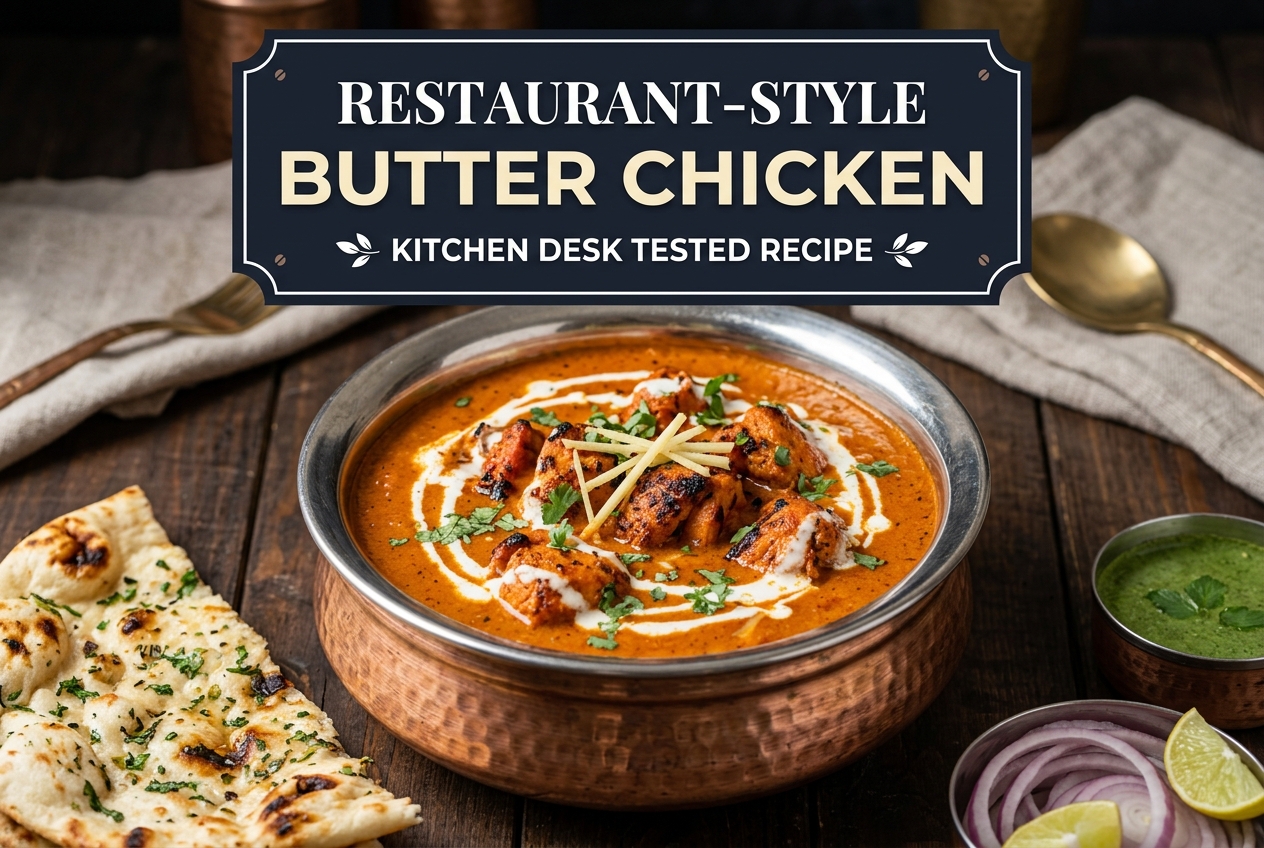
Serve butter chicken in a warmed shallow bowl with basmati rice, and put the rice on the plate first so the gravy can run into it rather than pool on top. A plain long-grain basmati cooked in salted water and rested is better here than a biryani or a pilaf; the sauce is carrying enough flavour that a spiced rice competes with it. Bread on the side is close to mandatory, and naan or a soft roti torn and dipped is the way most people eat it, but plain steamed rice with a spoon is just as traditional. Around the bowl, keep things cold, sharp and uncooked: sliced raw onion with lemon, a cucumber and tomato salad with mint, a spoonful of mango pickle or lime pickle, and a bowl of raita to cool the heat. This is a rich dish, so resist adding another creamy side. To drink, a salted lassi or plain cold water works better than anything sweet, and if you want wine, a dry Riesling or a lightly chilled Gamay handles the fat and the acid better than a heavy red. It also tastes better the next day, so do not apologise for the leftovers.
Why It Tastes Better Tomorrow, and How to Reheat It
Tastes even better on day two as spices meld. Store covered in the refrigerator for up to 4 days.
Reheat slowly over medium-low heat with a splash of water to loosen the thick gravy.