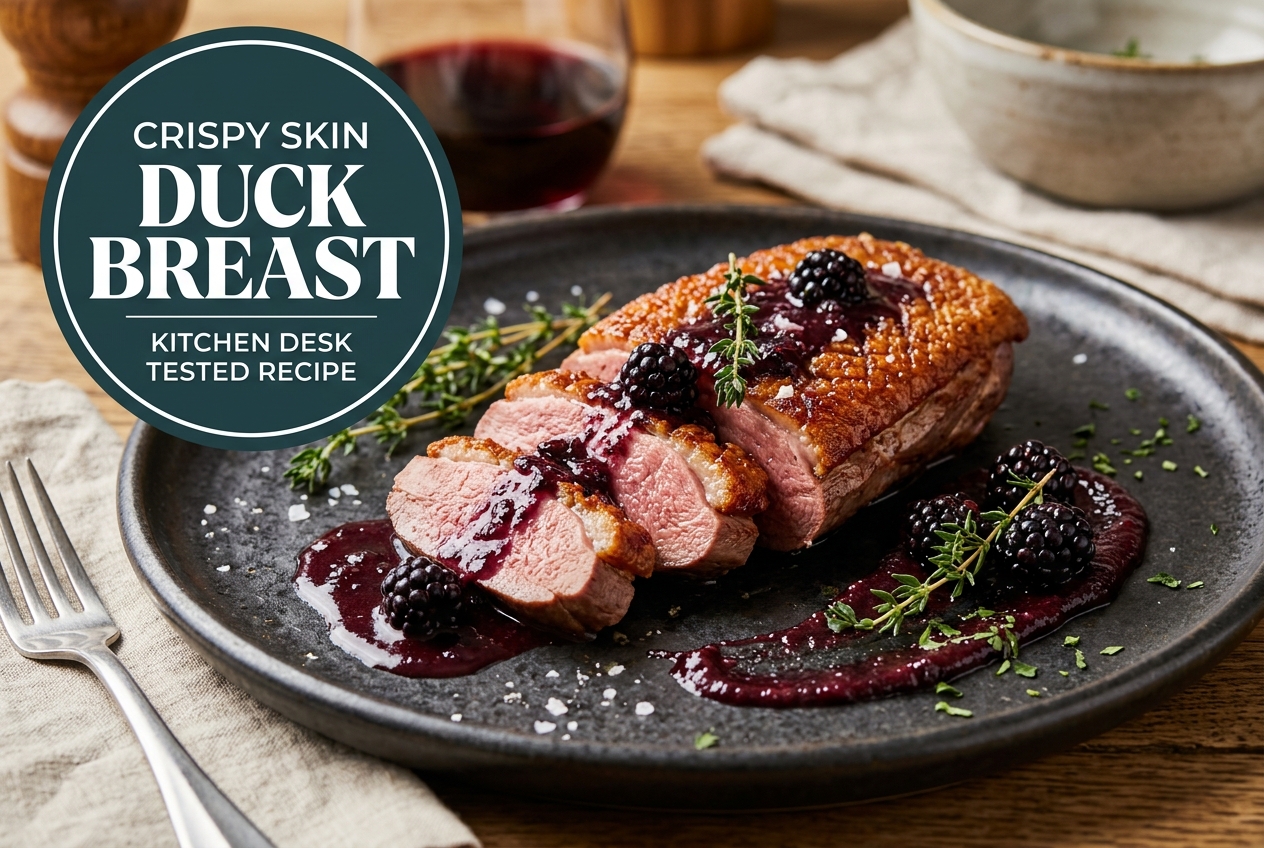
Why the Skin Needs Fifteen Minutes and the Meat Needs Three
There is more going on under a duck breast's skin than most people expect. Beneath it sits a layer of subcutaneous fat that can run 6 to 8mm thick on a Moulard magret, and beneath that the pectoral muscle behaves like red meat: dark, rich in myoglobin, and at its best somewhere around 54°C (130°F). Drop a cold breast into a screaming-hot pan the way you would a steak and the skin's surface scorches within seconds, sealing a layer of raw, gelatinous fat underneath and pushing the meat past pink into grey and livery long before the fat has begun to render. The skin needs about fifteen minutes. The meat needs about three. Almost every mistake with duck breast comes from treating those two numbers as though they were the same one.
The cold-pan start is what makes those two timescales possible. Set the breast skin down in a dry skillet that has not been heated, put it over low to medium-low heat, and the pan and the meat climb in temperature together. Duck fat is roughly half oleic acid, so it starts softening around 35°C (95°F) and is fully liquid well below 100°C. You never need a hot pan to get it moving. Over twelve to fifteen minutes at that gentle heat, most of the fat layer liquefies and runs out into the pan. Just as importantly, the heat reaching the meat has to cross that fat layer first, and rendered fat conducts heat poorly, somewhere around a quarter as well as water. The fat is being cooked out of the skin at the same time as it is shielding the muscle behind it.
Scoring is what lets the fat leave. A close crosshatch cut through the skin and the fat, spaced about 6mm (1/4 inch) apart, opens channels for the rendering fat to escape and gives the moisture underneath somewhere to go. It also puts more skin in contact with the pan, so more of it browns at once. The blade must stop at the meat. Cut into the muscle and you have opened a second channel, this one for juice: as the breast cooks, protein-rich liquid leaks into the pan and boils against the skin, and the skin that was dehydrating is now sitting in a puddle of its own juices. You will know it happened because the pan spits and the skin comes out mottled and chewy. Score with a light hand, on a slight angle, and stop the moment you feel the blade bite.
Once the skin is deep amber, the meat is usually close to where you want it already, which surprises people who expect to cook the breast through after flipping it. Heat has been crossing the fat layer for a quarter of an hour, and although fat is a poor conductor it still hands over a steady amount of energy, so the core often reads 45 to 50°C (113 to 122°F) by the time the skin is done. The flesh-side sear is there to colour the meat and close the last few degrees, nothing more. Two to three minutes over medium heat suits most breasts. If your thermometer already reads 48°C (118°F) before you flip, give it sixty to ninety seconds and pull it. This is the part that catches people out: a steak gets roughly half its cooking on each side, but a duck breast gets almost all of it on one, and the second side is never a mirror of the first.
The fat you pour off is not waste, and pouring it off is not optional either. As the fat layer renders, the pan fills with liquid fat, and if you leave it there the breast ends up simmering in a bath rather than sitting in a film. Skin can only brown once it has dried out, and while the surface is still wet its temperature is pinned near 100°C no matter how hot the pan is underneath. A shallow layer of fat is fine: the moisture escapes as steam and the skin dehydrates. A deep pool is not, because that steam has to bubble up through several millimetres of oil and the skin stays soft. Tilt the pan every four or five minutes and spoon the fat into a heatproof jug.
A wet brine, or a duck pumped with saline at the plant, will never give you crisp skin. Duck skin is roughly half water, and it has to lose most of that before it can climb past 100°C and brown. A wet brine adds more water to the skin and to the fat layer underneath, and salt holds it there. In the pan, all of it has to boil off before browning starts, which takes longer than the fat takes to render, and by the time the skin is dry the meat is past medium. Check the label before you buy: basted, enhanced, self-basting, or a retained-water percentage all mean injected. Dry salting does the opposite, drawing moisture out rather than adding it, and it is worth doing when you have the time.
Resting is where a lot of good duck goes wrong, and the culprit is steam. The breast comes out at 54°C (130°F) with juice under pressure inside muscle fibres that have contracted under heat. Left alone for eight to ten minutes those fibres relax and reabsorb most of it, and carryover heat lifts the core another three to five degrees. The skin, meanwhile, is still giving off moisture. Set the breast skin down on a board and that moisture condenses against the surface and soaks back into the crust you spent fifteen minutes building. Skin up, on a rack, with air underneath, and the last of the steam escapes instead. The rack does more work than the warm board most recipes suggest, because the point is not to keep the duck hot but to keep air moving under it. Do not tent it with foil, and do not lay it on a plate and cover it with a bowl to keep it warm. Both do the same damage.
Duck Breast Doneness, From Pan to Plate
| Doneness Target | Pull From Pan | Final Rested Core | What It Looks and Feels Like |
|---|---|---|---|
| Blue | 45°C / 113°F | 50°C / 122°F | Deep red and cool at the centre; only with duck you trust and a very sharp knife |
| Rare | 48°C / 118°F | 52°C / 125°F | Deep red, very soft, fat edge still yielding |
| Medium-Rare | 54°C / 130°F | 57°C / 135°F | Warm rosy pink, juicy and tender; the target for this recipe |
| Medium | 60°C / 140°F | 63°C / 145°F | Pale pink and noticeably firmer |
| Medium-Well | 65°C / 149°F | 68°C / 154°F | Barely a blush of pink; chewy, and the fat edge turns waxy |
| Well-Done | 68°C+ / 155°F+ | 72°C+ / 162°F+ | Grey and dry with a strong livery edge; there is no way back |
Ingredients
Checklist- 2 Moulard or Pekin Duck Breasts (approx. 250g / 9 oz each)
- 1.5 tsp Diamond Crystal Kosher Salt
- 1/2 tsp Freshly cracked black pepper
- For Pan Sauce: 1 Shallot (finely minced), 1/2 cup Dry Red Wine or Port, 1/2 cup Chicken or Veal stock, 1 cup Fresh Blackberries, 1 tbsp Cold butter, 1 sprig fresh thyme
Step-by-Step Method
- 1 Trim and Pat Bone-Dry. Trim any excess hanging skin around the edges of each duck breast. Pat the skin and meat thoroughly dry with paper towels.
- 2 Score the Diamond Lattice. Using a razor-sharp utility knife, score shallow diagonal cuts across the skin spaced 1/4-inch apart. Rotate 90 degrees and repeat to form a diamond grid. Cut through the fat but STOP before cutting the red flesh.
- 3 Season Heavily on Skin. Season both sides generously with kosher salt and black pepper. Rub salt into the diamond grooves to draw out surface moisture.
- 4 The Cold Pan Start. Place duck breasts skin-side down in a cold, unheated cast iron skillet. Place on the stove and turn heat to medium-low. Do not add oil; duck provides its own lubricant.
- 5 Render Slow and Steady (12-15 Mins). As the pan heats, fat will begin bubbling out. Every 4-5 minutes, tilt the skillet and spoon off excess liquid fat into a jar. Continue cooking until the skin is deep amber brown, wafer-thin, and crisp.
- 6 The 3-Minute Flesh Sear. Flip duck breasts to flesh-side down. Increase heat to medium. Cook for 2 to 3 minutes until the internal core registers 54°C (130°F) for medium-rare.
- 7 Rest and Build Pan Sauce. Transfer duck skin-side up to a warm cutting board; rest 8-10 minutes. Pour off all but 1 tbsp fat from skillet. Sauté shallot for 1 minute, deglaze with red wine, add stock and blackberries, simmer 4 minutes until syrupy, and swirl in cold butter off heat. Slice duck across grain and serve with sauce.
Reading the Skin: Notes From Testing
The Pan, the Blade and the Fat Jar
Diagnosing Flabby Duck Skin
| What Went Wrong | Most Likely Cause | The Fix Next Time |
|---|---|---|
| Skin charred black before the fat rendered | The pan was preheated, or the burner was set too high | Start in a cold skillet over medium-low and give the fat a full 12 minutes to liquefy |
| Juices leaked out and boiled the skin | The scoring cut through into the red muscle | Score through the white fat only and stop as soon as the blade bites |
| Meat tastes livery and chewy | Cooked past 65°C (149°F) | Pull at 54°C (130°F) and let carryover take it to a rosy 57°C (135°F) |
| Skin crisp at the edges, soft in the middle | Fat pooled in the centre of the pan and the breast sat in it | Pour the fat off every four or five minutes and use a heavy, flat-bottomed pan that makes full contact |
| Skin stuck to the pan and tore when flipped | The pan was hot when the breast went in, or it was moved before the skin released | Start cold and leave it untouched for the first six to eight minutes; it releases on its own |
| Grey band of overcooked meat under the skin | Heat too high during the render, or the flesh side was seared too long | Hold the render at medium-low, and sear the flesh side 60 to 90 seconds if the core is already near 48°C |
| Pan sauce tastes greasy and bitter | The fond burnt while the duck rested, or the butter went into a boiling pan | Build the sauce as soon as the duck comes out and swirl the cold butter in off the heat |
Key Advantages & Science
- ✓Produces glass-crackling, potato-chip-crisp skin with zero flabby fat.
- ✓Yields wall-to-wall rosy, tender medium-rare meat without liver notes.
- ✓Renders out 3-4 tablespoons of liquid gold duck fat for roasting potatoes.
- ✓Pan fond creates a world-class blackberry or port wine reduction in minutes.
Important Considerations
- !Requires careful scoring patience without slicing into the muscle.
- !Rendering takes 15 minutes of attentive low-heat monitoring.
- !Duck breast must be cooked medium-rare; overcooked duck tastes livery and dry.
Orange, Five-Spice and Other Ways to Finish It
The old French classic, and the easiest of these to get right. Deglaze with 150ml of fresh orange juice and the zest of half the orange, reduce by half, then add 100ml of stock and a tablespoon of Cointreau off the heat. A teaspoon of honey balances the bitterness of the zest. Skip the blackberries.
Rub the flesh side with a quarter teaspoon of five-spice before it goes in the pan. Once the duck is resting, deglaze with a tablespoon each of honey, soy sauce and rice vinegar and reduce to a sticky glaze. Serve with steamed greens and plain rice. The star anise is strong, so keep the rub light.
Press cracked green peppercorns into the flesh side before searing. Deglaze with two tablespoons of cognac and let the alcohol cook off, then add the stock and finish with the cold butter. Sharper and more savoury than the blackberry version. Use brined peppercorns, not dried black ones.
Soak 60g of dried cherries in 100ml of port while the duck cooks, then use the port to deglaze and add the cherries with the stock. Works all year, unlike fresh blackberries, and dried fruit gives the sauce more body. Reduce a minute longer than you would with fresh fruit.
What to Serve With Seared Duck Breast
Serve duck breast on warm plates rather than hot ones. A plate straight out of a hot oven will steam the skin from underneath and undo the crust in the time it takes to carry it to the table. The blackberry reduction does the sweet work on the plate, so the rest of the meal should lean sharp and earthy. Braised red cabbage with vinegar, lentils cooked with a bay leaf and a spoonful of the pan sauce, crushed new potatoes roasted in the rendered duck fat, celeriac or parsnip purée, roasted beetroot with a little orange zest, or a bitter-leaf salad with a mustard vinaigrette all work. Something pickled is useful too, whether quick-pickled shallots or cherries, because acid cuts the fat between bites. Keep green vegetables on the bitter side: charred broccolini, wilted chard, or spinach with a squeeze of lemon. To drink, Pinot Noir is the safe answer and Syrah the more interesting one, while a dry rosé or an amber ale handle the fat better than most people expect.
Reheating Duck Without Losing the Crackle
Reheat duck breast skin-side down in a dry skillet over medium heat for 3-4 minutes to restore crackling skin.