What Heat Does to Beef, Degree by Degree
| Internal Temp | Meat State | Collagen Behavior | Visual & Texture Clue |
|---|---|---|---|
| 50°C - 55°C | Medium-Rare | Myosin denatures and the muscle tightens | Firm pink interior; connective tissue still chewy and tough |
| 60°C - 68°C | Medium to Well Done | Actin denatures and moisture is squeezed out hard | Greyish meat; this is the driest and toughest point of the range |
| 71°C - 82°C | Braise Active Zone | Collagen begins unwinding into gelatin | Fibres start to separate; the sauce thickens and turns glossy |
| 83°C - 94°C | Fully Tender | Gelatin dissolves into the sauce and body peaks | Meat yields to a fork with no resistance; sauce coats the back of a spoon |
| 95°C+ | Boiling Danger Zone | Proteins shred and the gelatin breaks down again | Chalky, stringy meat that falls apart into mush |
| Chilled overnight, about 4°C | Set and Firm | Gelatin sets into a soft gel and the fat solidifies | Fat lifts off in one sheet; the sauce is a firm jelly before reheating |
What Three Hours of Braising Actually Does
Chuck and short rib are not tough by accident. The muscles that do the most work carry the most connective tissue, and that tissue is collagen, long triple-helix proteins wound into cables that make raw meat chew like rubber. Heat alone does not fix it. Held between roughly 71°C and 96°C (160°F to 205°F) in a wet environment, collagen unwinds and converts into gelatin, and that conversion takes time: somewhere between two and four hours for two-inch cubes. The gelatin is what gives the finished sauce its body, and it is also what makes the beef taste juicy even though the muscle fibres have squeezed out most of their own water. Above that range the conversion is quick but the fibres shred apart. Below it you can braise for six hours and the meat will still be tight.
Red wine goes into a braise for its acid, but it has to be tamed first. Raw wine carries ethanol and aggressive tannins that taste thin and bitter when they are sealed in a pot for three hours, because under a lid the alcohol has nowhere to go. Boiling it hard in an open pan for eight to ten minutes drives off most of the ethanol and softens those tannins, leaving the fruit, the acid and the colour behind. The acid is doing mechanical work as well as flavouring the sauce: a mildly acidic braising liquid speeds up the collagen conversion, which is why a Bourguignon comes together noticeably faster than the same cut braised in plain stock. Reduce the wine first and taste it. It should be pleasant to drink on its own before it goes anywhere near the beef.
Browning the beef is the step that decides whether the finished sauce tastes deep or merely brown. Beef browns through the Maillard reaction, in which amino acids and reducing sugars on a dry surface recombine into hundreds of new aroma compounds once the surface passes about 140°C (284°F). Those compounds dissolve into the braising liquid when you deglaze, and they are most of what you taste as savoury depth. The catch is that a wet surface cannot climb above 100°C, so the beef has to be genuinely dry and the pot has to be genuinely hot. Crowding the pot drops the temperature and the cubes steam grey instead. Three batches in a wide pot is not fussiness. It is the difference between a sauce with depth and one that tastes like gravy from a packet.
Which cut you buy matters more than any technique in this recipe. Chuck and short rib are laced with collagen and intramuscular fat, and both of those break down over a long braise. A lean cut like sirloin, rump or round has almost no collagen, so there is nothing to convert into gelatin and nothing to lubricate the fibres as they contract. Braise it for three hours and you get dry, stringy meat sitting in a thin sauce, because the moisture has been squeezed out with nothing to replace it. Fat and connective tissue are not a compromise you tolerate in a braise, they are the ingredient. Look for a chuck roast with visible white threads of fat running through the muscle, not just a fat cap on the outside.
Pearl onions and mushrooms are cooked separately and folded in at the end for one reason: three hours is far longer than either can survive. Mushrooms are mostly water, and simmered that long they give up their liquid, collapse, and lose the browned, meaty flavour that only comes from a fast sauté. Pearl onions do the same thing more dramatically, dissolving into the sauce and leaving nothing behind but a slight sweetness. Cooking them apart lets you brown them properly, which is where their flavour actually comes from, and adding them in the last ten minutes keeps them whole and firm. It costs an extra pan and about fifteen minutes of work, and it is the difference between a garnish you can see on the plate and a cloudy sauce with soft lumps in it.
There are two ways to thicken a Bourguignon and they behave quite differently. Flour, dusted onto the vegetables and cooked for a couple of minutes before any liquid goes in, gelatinises as the braise heats and gives a sauce that is thick from the start and stays thick. A reduction-thickened sauce relies on the gelatin drawn out of the beef plus whatever liquid boils off, so it thickens late and slowly and stays looser. Flour is more forgiving and it is what most home recipes do. Reduction tastes cleaner and glossier, but you have to boil harder at the end and accept that the sauce will thin again if you reheat it. This recipe uses a small amount of flour as insurance and then reduces at the end for the finish, which is the pragmatic middle ground.
Nearly everyone who cooks this says it is better on the second day, and that is not nostalgia. A braise is an emulsion of fat, gelatin and liquid, and it is still settling when the pot comes out of the oven. The fat has not fully dispersed and the gelatin is still dissolving. Chilling it overnight does two useful things at once. The fat solidifies on the surface and lifts off in a single sheet, so you degrease without losing any sauce with it. And the flavours keep exchanging, because the wine, the aromatics and the beef fat have hours of contact at fridge temperature to even out. Reheated gently it comes back together glossier than it was. If you have time for nothing else in this recipe, cook it a day early.
Ingredients
Checklist- 1.5kg (3.3 lbs) Well-Marbled Beef Chuck Roast, trimmed and cut into 2-inch cubes
- 200g (7 oz) Thick-Cut Smoked Bacon or Pancetta, sliced into lardons
- 1 bottle (750ml) Dry Red Wine (Pinot Noir, Burgundy, or Côtes du Rhône)
- 500ml (2 cups) Dark Rich Beef Stock or Bone Broth
- 2 tbsp Tomato Paste
- 4 cloves Garlic, smashed
- 1 large Yellow Onion, diced & 2 Carrots, sliced into 1-inch rounds
- 300g (10 oz) Pearl Onions, peeled
- 300g (10 oz) Cremini or Button Mushrooms, quartered
- 2 tbsp All-Purpose Flour
- Fresh Bouquet Garni (3 thyme sprigs, 2 bay leaves, parsley stems tied)
- 3 tbsp Butter, divided
- Kosher salt and freshly cracked black pepper
Step-by-Step Method
- 1 Render the Lardons. Place sliced bacon in the cold Dutch oven over medium heat. Cook slowly for 8-10 minutes until crisp and golden brown. Transfer lardons to a bowl with a slotted spoon, leaving fragrant rendered pork fat in the pot.
- 2 Deep Brown the Beef in Batches. Pat beef cubes thoroughly dry with paper towels; season with salt and pepper. Sear in the hot pork fat in 3 separate batches (never crowd the pot) for 3-4 minutes per side until deeply browned. Set aside with the bacon.
- 3 Sauté Mirepoix and Dust Flour. Add sliced onions and carrots to the remaining fat; cook 5 minutes until soft and caramelized. Stir in tomato paste and garlic for 1 minute, then sprinkle flour over vegetables and stir for 2 minutes to cook out raw starch.
- 4 Deglaze and Simmer with Wine. Pour in half the wine, scraping up all browned fond from the bottom. Pour in remaining wine and beef stock. Return beef, lardons, and any resting juices. Submerge bouquet garni.
- 5 Low-Temperature Oven Braise. Preheat oven to 150°C (300°F). Bring Dutch oven to a bare simmer on stovetop, cover with tight lid, and transfer to lower oven rack for 2.5 to 3 hours, until beef is fork-tender.
- 6 Sauté Mushrooms and Pearl Onions. In a separate skillet, melt 2 tbsp butter over medium-high. Sauté mushrooms until browned (6 mins). In the same pan, brown peeled pearl onions with 1/2 cup water until glazed and tender.
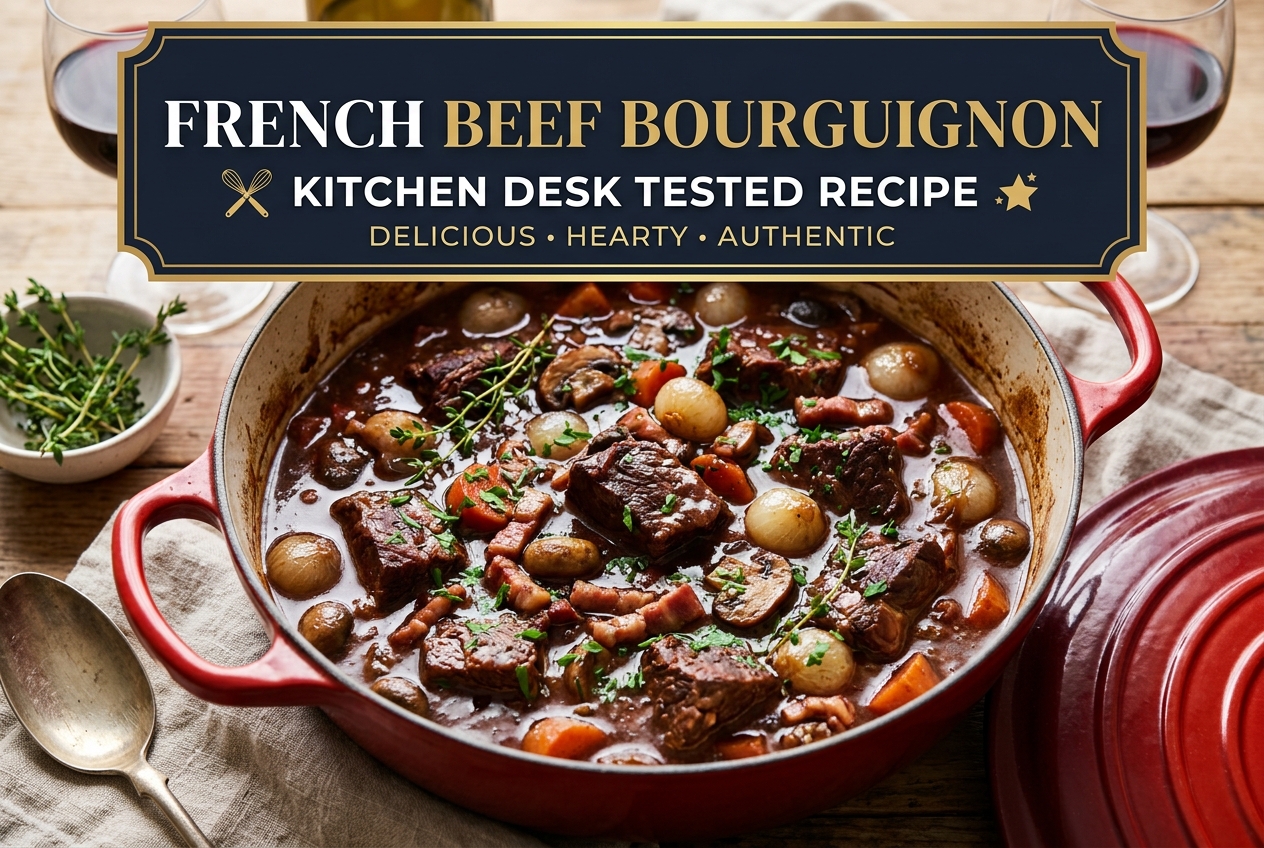
- 7 Combine, Skim, and Finish. Remove Dutch oven from oven. Skim excess surface fat. Fold in glazed pearl onions and browned mushrooms. Simmer uncovered on stovetop 10 minutes until sauce coats the back of a spoon. Rest 15 minutes before serving.
The Pot, the Lid and the Skimmer
Cook It a Day Ahead: Notes From Testing
Fault Diagnosis: Tough Beef and Thin Sauce
| What Went Wrong | Most Likely Cause | The Fix Next Time |
|---|---|---|
| Beef turned out tough and stringy | The pot boiled rather than simmered, so the fibres shredded while the collagen was still converting | Hold the oven at 150°C (300°F) and check that the liquid is barely bubbling, with a slow bubble breaking the surface every second or two |
| Sauce tastes bitter and harsh | The wine was not reduced first, or it was a heavily oaked bottle that turned astringent over three hours | Boil the wine down by half in an open pan before it goes in, and use an unoaked wine you enjoy drinking |
| Sauce is thin and watery | Too much liquid went in, or very little evaporated under a tight lid | Lift the meat out with a slotted spoon and boil the liquid uncovered for 6 to 8 minutes until it coats the back of a spoon |
| Sauce looks greasy and pools on the surface | The fat was not skimmed, or a hard boil pushed it into the sauce as droplets that never emulsified | Chill the pot and lift the solid fat off in one piece, or skim with a ladle and blot the surface with paper towel before serving |
| Mushrooms and pearl onions dissolved into the sauce | They went in at the start of the braise instead of at the end | Sauté them separately and fold them in for the final ten minutes only, so they stay whole and keep their browned flavour |
| The meat fell apart into shreds | It was braised too hot or too long, past the point where the collagen has converted and the fibres begin to disintegrate | Start checking at two hours with a fork; the beef should resist slightly and then give, not collapse under its own weight |
| It tastes flat despite three hours of cooking | The wine was not reduced so the sauce is dilute, or it was never salted properly at the end | Boil uncovered for 10 minutes to concentrate the sauce, then taste and salt; a splash of vinegar or a knob of cold butter off the heat will lift it further |
White Wine, Slow Cooker and Other Directions
Swap the red wine for a dry white Burgundy or another unoaked Chardonnay, and use veal or chicken stock instead of beef. The result is lighter and more aromatic, closer to a blanquette. Cut the tomato paste back to one tablespoon so the sauce does not turn pink.
Brown the lardons, the beef and the vegetables in a skillet first, and deglaze with the reduced wine. None of that can be skipped, because a slow cooker will not brown anything. Then transfer it all and cook on low for seven to eight hours. Cut the stock by a third, since a slow cooker loses almost no moisture.
Bone-in short ribs braise to a richer, fattier result and are harder to overcook because each piece is thicker. Expect to add 30 minutes and to skim considerably more fat at the end. Leave them as individual ribs rather than cubing them, and brown them on all four sides, which takes longer than it sounds.
Replace the beef with 800g of mixed mushrooms, including a handful of dried porcini soaked and chopped, plus 200g of cooked lentils for body. Use vegetable or mushroom stock, keep the wine, and braise for only 45 minutes. Add a tablespoon of soy sauce with the stock to do the work the gelatin normally would.
Key Advantages & Science
- ✓Transforms economical tough beef chuck into luxurious, fork-tender meat.
- ✓Tastes exponentially more nuanced and complex on day two after chilling.
- ✓Freezes exceptionally well without losing texture or sauce emulsification.
- ✓Provides rich natural gelatin body without powdered gelatins or cornstarch.
Important Considerations
- !Requires 3.5 to 4 hours of slow, attentive baking time.
- !Browning beef in small batches requires patience to avoid pan steaming.
- !Requires a genuine dry full-bodied red wine (Burgundy Pinot Noir or Côtes du Rhône).
What to Serve With Beef Bourguignon
Bourguignon wants something plain underneath it that will soak up sauce without competing. Buttered egg noodles are the classic for good reason: they are mild, and the twists hold sauce. Mashed potatoes work just as well, particularly if you keep them loose and buttery rather than stiff, and so does a soft polenta or a dish of crushed boiled potatoes with parsley. Thick slices of sourdough, toasted and rubbed with garlic, are enough on their own for a lighter meal. Alongside, a dish of steamed greens or a plain butter lettuce salad with a sharp vinaigrette cuts the richness better than anything heavier. Do not serve it next to another strong flavour, so no blue cheese and nothing heavily spiced, because the wine and the beef are already doing a lot. To drink, the wine you cooked with is usually the right answer, a red Burgundy or another Pinot Noir. If you cooked with something fuller like a Côtes du Rhône, pour that instead. A dry cider or a good amber beer also works surprisingly well. Skip anything heavily oaked. It makes a dish this rich taste muddier than it is.
Reheating Bourguignon Without Breaking the Sauce
Refrigerate in a covered container for up to 4 days. Reheat gently in a saucepan over medium-low heat.
Freezes exceptionally well for up to 3 months; thaw overnight in the refrigerator.